A chronicle of Mike and Julia's adventures creating a home on the Missouri range...

Monday, February 29, 2016

Last minute preparations

     I’m writing this post from a hospital bed where I have been marooned for monitoring after a successful “external cephalic version” that flipped our formerly breech baby. While I am overjoyed to now be carrying a healthy head-down 38 week old, I am also feeling increasingly panicked about the impending responsibility of bringing a tiny helpless baby into our homesteading lives. As we walked into the OB floor of the hospital this morning, we passed a newborn being wheeled down the hall and my stomach burst into butterflies. Ack! How are we possibly ready for such a little being to become our reality? I would gladly accept the sore feet and back, the uncomfortable sleepless nights, and the constant need to urinate in exchange for a little more time to prepare.

Before, total chaos!
      One reason for this is our house—while we have made good progress in some regards, I can’t help but look around and think “this is not ready for a baby to inhabit”. Perhaps it is a failure of imagination on my part, because I know others have birthed babies into far less comfortable settings (ahem, away in a manger?) In fact, two of our good friends who are moving onto land in our neighborhood this spring just found out that—surprise!—they are expecting an addition way sooner than they intended to be, complicating plans for building a small house and completing a masters degree program. While I feel confident on their behalf that there will be a imperfectly perfect way forward and that all will eventually be well, I can’t seem to muster the same faith in our relatively settled situation.


Shelves in the closet? Happy thought indeed! 
     I’ve gone through a series of conjectures about what missing piece of our house will yield a sense of calm preparedness in me. First I thought it was the flooring: I thought if that was just finished, our house would feel ready. But once Mike installed the final piece, all I could see was the clutter of tools and boxes all over the nice finished floor. So I built shelves in our closets and went on an organizing mission to get everything up and away. This definitely improved the lay of the land, but the feeling has lingered. My next thought was perhaps having the bathroom completed would help the house feel ready for an onslaught of midwives and family and visitors? So we commenced with plumbing and tiling and bathtub moving, as well as sink vanity and compost toilet construction. While the room still needs a door, trim and running water, it feels useable. Still.

      The next glaring deficit has been our stairs, inside and out. We have been using a step ladder for years to climb up and down to our deck without trouble, but now all I could picture was tripping on the rungs with an infant in tow. So one warm day I determined to finish a set of stairs and dragged Mike into assistance with heavy lifting. Another check off the list. But what about inside? Those stairs are now screaming to me “death trap!” Meanwhile Mike has been heroically handling our heavy duty chores—hauling buckets of water from our cistern (which is nearly full of water, but still awaiting a pump to eliminate the middleman step), chopping and managing the firewood and stove, and more—all while also installing flooring around the house. He just finished our upstairs bedroom with beautiful black walnut flooring. Now, as you might have guessed, I have my mind set to building a bed frame and closets, perhaps wishful thinking at this point unless I can transform myself into superwoman!


      We have been postponing unpacking our bed, linens, clothes and baby paraphernalia until the floor was finished. In fact, our changing table has been housing our tool and fastener collection for the better part of a year and has only last week been liberated for domestic duty. Surely having a bedroom set up will help me feel nested and ready… right? While we are forgoing the pregnancy right-of-passage of decorating a nursery, it would probably help to have some signs of an expected baby somewhere in the house, I would think. I keep telling myself there will be time for unpacking before the baby comes, and if not? If the stork comes early? Then hopefully my friends are right when they point out that all the baby really needs at first is us. 


      In case you haven’t noticed the trend, the list of to-dos seemingly grows longer the closer we get. I know there isn’t enough time for the house to be completed by the time I am full term, and inevitably I too will have to surrender to imperfect perfection. Oddly, the deadline is ambiguous—perhaps in a few days or perhaps in a month?

      I write these words to the clicking metronome of the fetal heart monitor—the computer beside me sounds out the beats per minute. 141. 138. A kick or two sends it up to 155 and eventually back down to a flat line lull. The baby must be asleep. Watching the four tiny chambers of the heart earlier with their rapid flutter of valves pulsing in the swirling black and white ultrasound image was a visceral reminder that my will—to finish our house projects and clean and prepare—is only one will in this equation. There are now two wills at work in this body (one that very stubbornly wanted to remain head up until this morning!) and I have to make room. Our friends who are parents assure us that loss of control in the birth process is the first in a long series of surrenders that impress upon you your total vulnerability in the relationship: you can’t control how the birth goes or the health of the baby. You have to let go over and over and over as they learn by pushing further and further away from you, indefinitely. Perhaps accepting that is the hardest work of being a parent.


    Coincidentally I just got the all clear to rejoin the outside world again, so I should wrap up and keep moving forward with the day—into the unknown, yes, but also perhaps to squeeze in a little more plastering while the light holds and I still have a little more time!

Thursday, February 4, 2016

Winter homecoming


    Mid- January, Mike and I packed up our old conestoga wagon and made the long trek back to Missouri, arriving in the midst of our first Missouri winter! It has been so amazing to be here in this beautiful spare landscape at this time of year, especially because we can enjoy the beauty of it from inside our own home. I know how basic that sounds, but I have been reveling in the fact of it: the snow is falling outside, the wind is howling, rain is pounding, and the elements are performing their messy winter alchemy while we are dry, warm and protected inside this space. Okay, okay, you get my excitement about our home-dwelling reality... So what about the details? Is the stove working out? The cistern?

    Let me say that things did not start out well. When we first drove up to our house, we had no idea what to expect. Our neighbor Brian had kindly offered to light a fire in our stove earlier on our arrival day, and so despite the frigid temperature outside, we had hopes of entering a toasty house. Wrong. It was just above freezing inside, only slightly warmer. Still, bundled under every blanket we had, we slept warmly that first night with high hopes for our stove’s performance the next day. But the next few days of feeding the stove all day didn’t bring up the temperature inside beyond 50F.  I think we both began to despair that we had failed. Maybe we hadn’t insulated well enough, we overestimated our stove’s heating capacity, we designed for passive solar heating all wrong. Mike pointed out one night that he could see his breath. We were sitting mere feet away from our stove. Something was definitely wrong.

      So what is a frustrated, shivering person supposed to do but problem solve the situation? We couldn’t produce more heat, so how could we lose less heat? I thought about the concepts in "Passive House" design: create a super-tightly insulated envelope so that not much heat or cold needs to be generated to condition it with. To determine the weak, leaky points in the structure, a series of blower tests are used, along with thermal scanners to see where air infiltration is happening. Although we didn’t have access to such equipment, we felt through the house for drafts and such. Perhaps not surprisingly, around several hastily installed windows and doors there were some noticeable streams of cooler air coming in. The glass on our double-pane windows was also frigid, and then there was the most glaring opening we hadn’t bothered to close in our haste to leave: the hole for the stovepipe going through our roof. Goodbye heat, hello cold drafts! There was very likely a thermosyphoning effect going on between the two. The last point we considered was that our thick clay-plastered walls were acting as a thermal mass, retaining the cold as we tried to introduce heat. That effect would reverse with time, but it took a good week or two.


      So after some work installing weatherstripping, spraying several cans of “Great Stuff” insulation, making thermal shades we can lower at night, and sealing up the hole around the stove pipe, I am very very relieved to report that we are warm! Which presents its own problem... how to regulate our stove to yield temperatures above 55F (which seems to be the temperature average when not running the stove for a day) but below 85F (a miserable temperature to try to sleep in), all while also meeting our cooking needs for the stove? A programmable thermostat really has its charms, which are hard to replicate the old fashioned way!


      We have had a learning curve cooking on the stove as well. Our stove gets very very hot, which has yielded some burned dishes and skin (yikes!) as we have gotten used to its subtleties. There is a perpetually shifting range of temperatures on the cast iron cook top, depending on where you place a pot or pan, closer or farther from the firebox. The stove box is also somewhat fickle, ranging from 200 to 700 F (!), but we have found most temperatures cook most baked items decently if left in the right amount of time. Finally we have been able to cook pies, roasts, pizza and other baked dishes that we hadn’t been able to cook decently in our outdoor kitchen. Also, thanks to the cold temperatures outside, we have had “refrigeration” via our cooler. For the most part though, food-wise we have been eating lots of our stored root crops from last year’s garden—sweet potatoes, potatoes, squash, pumpkins, apples—as well as canned tomatoes, pickles, beets, etc. And let me not forget pork! We aren’t sick of it yet but I can see the potential… 


     And though winter, of any season, is the obvious candidate for taking some down time away from work—cooking, visiting friends and neighbors, reading by the stove and making things—our main goal the past month has been to get further along on the house before the baby is due to arrive and our time, energy, and focus shift in a new direction. Currently as I write, Mike is pounding away on floor installation (using a loud, hammer-drive floor nailer… this baby has a promising career as a drummer I think!) I have been tackling work on the bathroom, and am determined to see it functional by March. (Let me just say, an outhouse in January does not have the same allure as an outhouse in May…) To start with, I have plastered the sheetrock walls with a finish lime plaster which I then lime-washed with some blue iron-oxide pigment mixed in for color. Lime is a great natural finish for areas where certain hygienic qualities are desired, as well as breathability, as it won’t trap moisture. My friend Sarah pointed out to me that the cheese-aging cellars in France where she lived and worked were lime plastered for that reason—no strange mold strains growing there! So, perfect for a humid area like a bathroom. Next to come are wainscoting and a tile floor and then our tub can finally get installed. Let me just say that bathing in a galvanized wash tub is also losing its farmhousy novelty!


      As the baby grows larger and larger, my range of motion and energy are shrinking, but I am still awkwardly and slowly able to work. I guess this is around the time in their pregnancies that many women go into a frenzy nesting and cleaning their homes. While I might like to be at that point with our home, our reality is much clutter, work mess, and assorted piles/boxes/furniture endlessly being shuffled around. Still, I can’t complain, especially when compared to the birth stories of many of our neighbors and friends in nearby communities who welcomed babies home to tents or walls of unplastered strawbales and the like. The babies don’t seem to notice, go figure. And to see their beautiful children and homes now, I know we will be there too someday soon… all will be well!


     At any rate, we are still making time to relax and have fun in our last child-free months. Our community gets creative in winter. For example, with ice skating tag in a giant snow maze at our neighbor’s pond.  (I cautiously pushed a chair around like a walker so I wouldn’t topple over, which was pretty soon seated by a small girl too young to skate!) Yes, it is hard to imagine what our lives here will soon look like with a little one in tow. But we give thanks for all the community support around us, near and far, helping us figure out the way into parenthood!

Saturday, November 21, 2015

Season Finale: Moving In


    Our fall season on the land has fully fallen: we just closed up the house and packed up our car to head east for a little winter break. Truth be told, September, October and November have flown by in a flurry of activity, and subsequently I have fallen way behind in my updates. So—warning--this could be a marathon blog post. But like all good season ending episodes, there is an unexpected twist at the end, so keep reading!
 

    First and most importantly, we finally moved in to our house! Far from being my dream moving-in scenario (fully finished floors and walls, closets and shelves, all polished and ready for our belongings to be unpacked), our “moving in” is happening in fits and starts. We semi-finished one bedroom first—one clean space amidst the construction chaos—to sleep in. That means the wall surfaces are still rough plastered and partly sheetrocked, and the floor has underlayment nailed down but not a whole lot else. We set up extra strawbales as a bedframe and relocated the contents of our falling-apart-at-the-seams tent into the space and spent our first chilly night indoors (still chilly, but less so). It was then that I realized two things: having relative quiet whilst sleeping is such a luxury, and we weren’t quite there yet since our house apparently already had several occupants. Mice. Ugh.

Campsite cooking on the rocket stove

     Thus far we have coexisted with a lot of animal and insect co-inhabitants to varying degrees of annoyance and tolerance. I can shrug off big black rat snakes, marauding opposums, bats, hornets, and even palm-sized spiders hanging on the outside of our tent. But mice? I have never gotten past the point of total revulsion with them. Once when I was “home” alone, a mouse chewed through our tent and I came back to find it running around on our bed. I slept in our car that night until Mike could come back and get it out. Anyhow, fast forward through many hair-raising encounters with mice to the glorious point in our tenting existence when two stray cats showed up at our campsite. Within a week there were no more mice within a 20 ft. radius. Hallelujah! Apparently they all had moved into our house instead. (For the record, they are now out again, escorted by traps…)

 
     Not that our cats have been without their own challenges. For example, once in a classic “Pepe-la-Peu” style error, a local skunk started courting our black and white cat: every morning for a week at 5 am, the skunk would let off a blast of “come hither” scent in the direction of our campsite. This is not a pleasant smell to wake up to, but what could we do? We soon learned that if we pulled on surgeon’s facemasks in a state of half-lucidness, we could sleep through the worst of it. Yes, I’d say there is quite a bit that I won’t miss about campsite living: trying to start a fire in our rocket stoves in the driving rain, the spring explosion of ticks, the soot, the mildew, the flies… (I bet I’m really selling you on the great outdoors, aren’t I?)

     But honestly, the vast majority of our experiences living outdoors have been amazing. There are so many moments of jaw-dropping beauty and wonder that I have lost count. Waking up to the sherbert sky of sunrises and the beating of hummingbird wings. The dazzling night sky that arrests you when you stumble out of the tent at night. All of the perfect mornings spent in the sunshine and crisp air, eating pancakes and reading to each other, stopping to watch a hawk or V of geese or inchworm on its slow path. Waking on the first morning of frost to find a glittering world transformed. A low-flying night heron swooping in overhead on its way to our pond. I have to wonder if I will notice as many of these small wonders once we are living indoors…

Julia applying the watersealing "surface bond" coating

Form work and rebar ready for the cistern roof pour

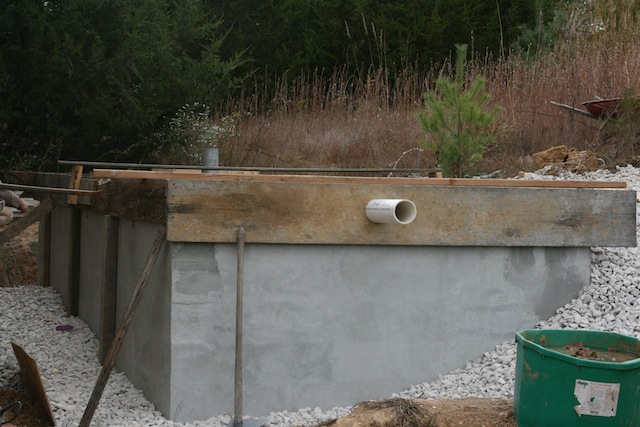
Post concrete pour, the overflow pipe sticking out

Mike and the trencher, digging out for the clean-out drain pipe

Clean out drain pipe going downhill
     But I digress. Our “moving in” progression was furthered by two more major developments. The first was finishing our water cistern and setting up a wash station inside (yay!). This process probably deserves its own blog post since it was so involved, but suffice to say, a big learning curve behind us, we now how have a tank holding rainwater behind our house! The second development was finally getting our wood stove fully installed. This seemed like it would be more straightforward than it actually was. Moving the stove in was fairly easy… that is, with a neighborhood of people helping. I built the hearth out of slate while Mike ground the rust away out of the old stove and got it in shipshape with new firebricks. Neighbor Don came with his tractor and hoisted the stove to porch level and from there a team of strapping young friends completed the move indoors. The complication came when it came to installing the stovepipe itself. It had to snake up to our roof through two stories and around several key load-bearing beams. Guessing angles and taking the plunge of actually cutting holes through the floor and the roof metal (ack!) was difficult and took three trips to an Amish-run stove parts store in Iowa to get just right. The cost of the pipe too was a doozy, almost three times what our stove cost (ack again!) But the feeling of heat emanating from the stove when everything was finally installed just right? Priceless.

Fitting the stove pipe
Moving the stove in

Making the cut through the roof (teeth gritted)


Installing the chimney cap

     I love this stove. It seems like the warm heart of our home is finally in place. I love cooking on it (imagine a giant hotplate with zones of heat, from “rapid boil” to “crock-pot slow cook” to “keep my mug warm”). I love that scrap wood from our land can power it. I love that it heats up our house in no time and keeps things toasty all night as it slowly releases its heat. I love that there is a water tank that sits on the back of it that keeps us in steady supply of hot water. I can’t imagine why these stoves were phased out in favor of kerosene and then gas ranges, except the one obvious caveat about it: someone needs to be around to keep it going. And without a personal Mrs. Patmore in the kitchen, I suppose that is an inconvenience. Still, it is a perfect fit for our house and homestead and I feel grateful for the heat it provides us.

Mike cooking pancakes and Autumn Olive syrup on the stove top


      Other developments on the house have been finishing our little dormer window area, starting the finish flooring (thanks to Mike and my father who have been nailing away at it, row by row), starting the finish plastering (now up on 2/3 of our downstairs walls), getting sheetrock up and mudded in various parts of our house where lath and plaster just wasn’t in the cards, and installing a gutter along our roof so that we can begin catching water in our cistern (thanks to our friend Augustine!).


Gutter installation

Our friend Beth leading a finish plaster demo

     My parents came to visit and were once again willing to help with construction. My mother pointed out to me that home construction has been a long family tradition, since her parents bought an old farmhouse on Washington Island, WI and hauled her and sisters up every summer to work on it, little by little. It took them ten years to complete and move in, during which she would sleep up in the creepy unfinished snake-and-mouse infested attic, so I suppose the construction compulsion is in my genes. My epigenetics too, since my mother was a construction project manager, working on sites up until the day I was born.

      I have been thinking about this a lot lately as I have been hard at work, hammering and sawing and hauling this and that: the complicated and intricate relationship between genes and in utero environment that partly shape who we become. Am I attracted to the creative, hands-on process of building a house because I spent so much time at construction sites in utero and as a young child, tagging along with my mom? My preschool teacher would take notes about my play tendencies—“playing alone with blocks again”—and my friend’s parents would also predict that I would become an architect or builder. And here I am, to nobody’s surprise.

    So I have to wonder about my own child, how is all this filtering into his or her life? Because, you see, I am pregnant! And have been for five months now, five months of almost non-stop construction. This has not always been easy, balancing the needs of a growing fetus (rest and non-stress) and the need to have a functioning home to raise a baby in (requiring much activity and accompanying stress!). But we have come a long way this year, and all has gone well so far with the baby’s growth. Now I can feel that the baby is quiet through the active parts of the day and moves around and kicks quite a bit when I am not moving. Has the noise of hammering and saws whirring become a muffled lullaby to this baby? Or has it been an annoyance? I have so much curiosity about this most amazing miracle unfolding within me, and it truly has added another dimension to an already full and special time in our lives. This baby and its arrival will become a part of the story of this house, and vice versa.

The second floor awaits our return...

     So with that revelation, I will leave you until mid-January, when we return to finish work on the inside of our house—the final push before a different kind of "final push", as it were. Until then, happy holidays and may your lives abound with small wonders too!

Thursday, November 5, 2015

Three (not so) Little Pigs


     We woke up early this morning with anticipation of the day to come. Today is butchering day! (Warning: somewhat graphic images of the day follow). As I write, a fire has been lit under the scalding tank, scraping bells are ready, and our friends and neighbors who have volunteered to help are probably eating breakfast and will begin trickling over. Only our pigs are blissfully unaware, and are probably sleeping in.

      In the interest of full disclosure, our pigs are no longer “little” and they are no longer “three” in number, but that is how they started out back in early summer; three very cute little pigs. Now they are enormous hogs and one has already been harvested a few weeks ago and delivered to Mike’s parents in Ohio where he may already be making appearances on a breakfast plate. That was Stubby (yes, we named them against our better judgment), and being the mischievous bully ringleader, he has not been missed by the other pigs or us (he often “hogged” all the food). He was adept at breaking out of their enclosure and leading the other pigs in romps through our woods and fields as we went chasing after them, coaxing and trying to round them back to the pig pen. So needless to say, he was an easy choice for first culling.

The day begins--scalding tank is heated and the pig has been killed

Pulling the pig into the scalding tank

Our other two pigs on the other hand were quite sweet and I feel sad at their parting. Smally and Spotty have definitely grown on me over the months, despite their horrible smell and their oafish clumsiness, stepping in their food dishes and knocking their water over time and time again. We have raised them on a diet of mostly ground corn, apples, whey left over from our neighbor’s cheese making, and food scraps, plus whatever they discover rooting up the ground since we never ringed their noses. Our good friend John Arbuckle has further perfected his hog raising system, planting fields of forage crops, and then rotating his pigs around in them. Doing this, he has managed to decrease their need for outside grain inputs considerably, to a quarter of former rations. Let me just plug his awesome pig product here, ROAM snack sticks (http://roamsticks.net/roam-snack-sticks/), made from pastured happy pigs, coming to a health food store near you. (Let me also just point out that the alternative snack sticks on the market are made from pork bought at discount when it is recalled. And yes, the FDA apparently allows this. You truly get what you pay for in our food system!)

Rolling the body back and forth in the scalding tank by using chains
Using bell scrapers to remove the hair


I have come to appreciate pigs as ultimate food composters. I used to feel frustrated when some food item went bad before we could eat it, but now I think, “bacon!” and toss it without remorse into the scrap bucket. Imagine if every restaurant or cafeteria had a few pigs out back to take care of food scraps… We would have a much more efficient, closed-loop food system. Instead, we send almost all food scraps to landfills where they become methane, a potent greenhouse gas, as they break down, and farmers grow massive amounts of corn and soy and other grains that go to feeding hogs (and other animals) in CAFOs. That would be “Confined Animal Feeding Operations”, not very nice places to be in if you are a pig, or a human for that matter.

We have been learning more this year about food systems, and looking into all of the uncomfortable dark corners that most people would prefer never to become aware of. One fascinating read if you too would like to delve deeper is Pig Tales: An Omnivore’s Quest for Sustainable Meat.  The author, Barry Estabrook, mentions a hog CAFO that he visited near us, “Smithfield Foods” in Milan, MO. We were aware of Smithfield’s existence before now, mostly because we know an elderly couple of environmentalists who have the total misfortune of having built their homestead on land that became adjacent to the CAFO. You can imagine how their air quality quickly deteriorated as the manure lagoon started filling from the excrement from thousands of hogs. That lagoon spills over in heavy rains, washing into the local watershed and seeping into groundwater. Ugh. Our friends have filed and won lawsuit after lawsuit against Smithfield and yet Smithfield just keeps paying out and returning to business as usual, undeterred. They are one of the largest CAFO operators in the nation, running several of the 20,000 CAFOS that currently exist in the US.

The pig is hoisted up to working level as baby Johanna and Regina watch

Mike and Brian saw the pig slowly in half after removing the head and organs

We have also been hearing about the human side of Smithfield’s operation from labor organizer and former CAFO worker Axel Fuentes. He makes an appearance actually in Pig Tales, and he also made an appearance recently at a local event viewing and discussing the film about hunger in America, A Place at the Table. He is part of the Latino community in Milan, which has exploded to 4,000+ since Smithfield started in the last decade. Most of these workers are illegal immigrants lured over to the US by promises in advertisements in newspapers and billboards that these factories put up in Mexico and other countries. The reality they find is pretty horrible (if they make it) and then they become trapped here.

Warning: don’t read this next paragraph if you want to keep eating cheap meat as usual, as it is a bit graphic!

At the film viewing, Axel Fuentes said something I find very disturbing. He pointed out that we quite literally still have slavery in this country, in fact, in the very county I live in. Illegal immigrants are abused and taken advantage of in all sorts of ways. At Smithfield, they work 12 hr. shifts and have a single 5 minute break in that time. That means many of them wear diapers because there are no bathroom breaks. And the work is dehumanizing, desensitizing, and brutal. I can’t begin to imagine. As a society, we can do way way better than this!

So! With that cheery news in mind, there are alternatives! There are so many amazing small family farms springing up all over this country with hardworking people like my friends John and Holly Arbuckle treating their animals with dignity, honoring their animal instincts for rooting and pecking and being able to move around. These people deserve way more support and frankly, they deserve to make a living whereby they can support their families from farming income. (CAFOs set meat prices so artificially low that it is hard to compete. Farming is mostly a labor of love as most farmers are just breaking even at slightly higher prices!) I know there are ways to access these alternatives in almost every part of the country and it is worth making a little more effort to seek them out. 

Dan and Mike work on carving up one pig into smaller cuts of meat

Teri, Brian and Steve work on the second pig, ribs in the foreground
Well, this is all getting a bit preachy and big picture, and as I write, the little picture is unfolding right outside: a group of neighbors has gathered to relearn forgotten skills and participate in a new yearly ritual. Our Amish neighbor Jake is going to be leading the first part of the process, scalding the skin and scraping the gristly hairs off (after the pigs are quickly and humanely killed). Then our friend John will help give pointers for butchering each hog into many smaller cuts which will be wrapped and frozen. While Brian and Teri have raised pigs before and have more experience, this is our first year and the help is really appreciated! Once wrapped and labeled, we will store the meat in a chest freezer at our friend’s house with hopes of one day powering a freezer with solar panels at our house. While this day will be hard in ways, we are taking our turn doing the unpleasant work of eating meat so that someone doesn’t have to 12 hrs. a day, 7 days a week.  

Brian, John and Mike holding future prosciutto?
Note from the end of a long day: Success! As the photos show, the day went really well. We are really fortunate to have many hands in the community willing to make light work of our arduous task!