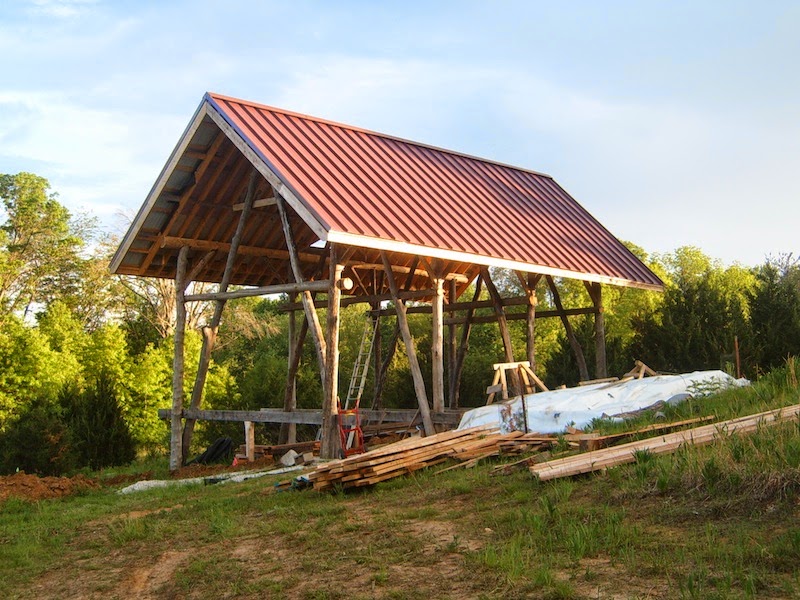
A chronicle of Mike and Julia's adventures creating a home on the Missouri range...

Thursday, June 12, 2014

Nature, red in tooth and claw

      Late spring in Missouri, I am learning to expect the full onslaught of natural forces. From tick population explosions, to voracious weed growth, to wild storms resulting in flooded roads and fields and mud everywhere, our world here spins uncomfortably out of control for a few weeks. Okay, maybe a month. I suppose we are not the only beings entering into the season with full energy to get growing and moving, but it does feel uncomfortable at times to be living outdoors in it all.

      Last week brought 6 inches of rain in two storms, one of which had our neighbors hitting their storm shelters and whatever glass-shatter-free safe zones they had indoors. It brought 90 mph winds, quarter-sized hale, and a heat lightning storm (lightning flashing every second, making for a strange strobe-like effect) that lasted four hours as I was counting before I fell asleep. We have been opting to weather out the fierce storms in our tent, mostly in order to help hold up the thin fabric walls from ripping apart in the high winds and to protect our campsite. I could feel hale driving sideways, hitting my hands in sharp pricks from the other side of the tent wall as I braced it. But fortunately the little thing held through the worst of it, as did our house frame, and we made it through with only a broken mug to show the damage in our outdoor kitchen of the harrowing experience. Though the next morning we woke to find our wood-chipped driveway full of little rivulets of runoff water, making their way down to our creek, having pushed all of our carefully arranged chips into a mass at the bottom of the hill. Argh. Still, as people in the area had much more serious damage to trees and roofs, I can't complain. An unexpected silver lining to all the rain has been that suddenly all of our dormant shitake-innoculated logs flushed and exploded in mushrooms! So we have been feasting lately. Plus the mulberries have popped in the first of the season's fruits, so delicious, very worth the purple-stained hands and mouth.


     As uncomfortable as it feels at times to be living in a soggy, tick-bitten, unpredictable world with little refuge in the way of shelter, it is also equally marvelous to be up close to it. To watch a giant blue-grey mass of storm clouds piling up and coming closer and closer, to wade down though the flooded field and watch the creek beds spilling over, to walk across a field and almost step on a giant black rat snake before its muscular scaly body writhes away, to witness the totally bizarre flight of a hummingbird's mating dance, or have a butterfly land on your arm.... all totally stop me in my tracks and thoughts with wonder. One of the most amazing natural events I have witnessed happened a few weeks ago when Mike and I were visiting our neighbors the Crawfords. We were out in the garden with them and their daughter Melanie chatting and doing little garden tasks on a beautiful breezy blue-skied afternoon when out of nowhere a frenzy of winds touched down in the pea bed and whipped up a big mass of straw mulch. This kind of thing may happen all the time without our seeing it, but the fact that the straw had been drawn violently up into the tumbling whirlwind made the normally invisible visible to us dumb-founded witnesses. We all had stopped mid-sentence, mid-task, and just stood riveted as the straw tumbled round and round, higher and higher into the air. We watched until we couldn't see it anymore, it had been lifted so high into the clear blue, some of it dropping delicately down to land on the tree tops in the distance. How did that come to be on such a mild calm afternoon? And so perfectly staged in front of us, the chance audience? I feel like a new pupil in the ways of the wild world, and I am learning to soak up the mystery of it all as it comes without definitions or easy answers, which my mind craves regardless.


     Okay, enough of the poetic! The brass tacks of what we have been up to lately with out little slice of  wilderness is that we have been putting in the floor on our house! After weeks of scouting out materials from local mills, people's barns, restores, and the like, we have spent the last week with my work-ationing parents (and guest star Aunt Jane) hanging joists and tacking on plywood underneath them to create what will be our insulated first floor. It is at its lowest point one foot off the ground (making for a tight squeeze, on our backs to get plywood hung), and on its highest point around three feet off the ground. Thanks to the help of my family, we were able to get the whole thing up in a week, and what a difference a floor makes in defining the "housiness" of a structure! No longer can we be mistaken for Missouri's largest and weirdest deer stand! The only problem with defining our first insulated cavity is that I have become a bit paranoid about mouse entry-points. No crack or hole seems too small, and we have taken some extra precautions to patch and reinforce weak spots. We also dug in our greywater pipes and exit-points from the house, burying the line away from the house a little ways to a spot where we can put in a greywater garden and fruit trees, (one day, with all the left-over energy we will have at the end of all this!) So now that we have drain pipes and floor in, we are beginning to think "walls," and with straw-baling season a few weeks away, we are right on schedule.


Tuesday, May 27, 2014

Digging In


        We have arrived back to Missouri for the spring, this year greeted at the end of a long drive by a wonderful sight: our house frame and roof still standing, cheering us home again! It feels good to be back with one heck of a season's tough work behind us, and one exciting season of work before us. Now that we have been here for about three weeks or so, I can say that our activities for this first month seem to be organized around a central theme--and that is digging. Digging drainage ditches, digging in little tree saplings, shoveling wheelbarrow after wheelbarrow of top soil and woodchips to add to our swales, turning up the soil in our one small garden bed, etc. Spring seems like a time for robust digging in, literally and metaphorically, into new projects. Not that I am complaining, because despite somewhat sore backs and tired bodies, it is all work that we are excited to be doing: each shovelful seems to bring our dreams that much closer to becoming realities.

Our little home away from home...

     I also can't complain about the moving-in process. Setting up camp this year has also been relatively painless and quick compared with our process last year (which involved building a covered living structure, setting up roof-catchment water systems, building storage systems in our shed, and getting our mulched outdoor-living areas established to name a few projects!) We were mostly unpacked and set up in one day, with some basic reorganization, planting pots and beds, and re-mulching in the following week. Our neighbors were also generous to feed us our first few days of meals while we got our kitchen set up for outdoor cooking again. In fact, the first weekend we arrived was fairly full of celebrations, potlucks, clothes-swaps and gatherings of various kinds. We arrived in time for this year's May Day celebration which involved erecting a May poll, music, dancing, weaving ribbons around and a big delicious feast. And despite having missed the first days of leaves budding out on trees, which is always kind of miraculous to witness, we also missed the last blasts of cold April weather and have for the most part been enjoying sparkling warm spring days.

May Day, with last year's may poll ready to become this year's campfire


     Although we are eager to start putting in the first floor of our house, what lies beneath comes first and tackling all the drainage issues has required a solid week or more of digging. Putting in perforated black drainage pipe and gravel around the perimeter of the house, and building little retaining walls out of "urbanite" (chunks of broken-up old concrete) around the banked earth of our north and east sides has been quite a bit of a work, shovelful by shovelful. We have also started thinking about how water is going to move in and out of the house, and we have dug in a ditch under the house for "greywater" (which is waste water from kitchen and bathroom minus "blackwater" from a flush toilet) to drain away and out to a greywater garden planted to absorb it close by. As we have muddled through these steps, I am once again struck by how much work and expense a basic house is to construct! Still, the creative process of it all is rewarding and in the end, I am sure we will value it all the more for all the work that has gone in.


     The spring rains this year have been much more paltry than last, and so our pond has not filled to full capacity. We thought we would be spending more time this spring planting out native wetland plants and starting to introduce fish into it, but instead we have opted to focus on planting out our hugel-swale system. You may remember this swale system from posts from our first year if you have been following the blog, but if not, they are basically ditches dug on contour on a south-facing slope on our land, about fifteen feet apart, and we added some rotting logs into the downhill mounds under the dirt relocated from digging. Last year they were looking a bit weedy, but we didn't have much time to pay them attention. This year they have been lavished with weeding, compost and topsoil, seeded with a mix of clovers to pull nitrogen from the air and fix it in the soil, and they are getting their first plantings! We ordered eight cultivated pear and apple trees to start, and added in twenty-five nitrogen-fixing shrubs, called false blooming indigo, available from the conservation department. We also are planning to add in some more nitrogen fixers (to be discussed in the next post)and what, in the permaculture world, are called "dynamic accumulators," which all have long tap roots to draw up deeper levels of nutrients and make it available at the surface level. These are things like comfrey, burdock, horseradish, and jerusalem artichoke. Finally spending time to get these planting "guilds" established has been very exciting, and so work that it has taken has flown by fairly easily.


     Among our native "neighbors" that are becoming more and more familiar to us--treefrogs, inchworms, monarchs and swallowtails, hawks and vultures, songbirds, mice (not such a welcome one), snakes, herons, migrating geese, wild turkeys, rabbits, squirrels, and many more--we have some new human neighbors down the road. After considering it for a year, John and a very pregnant Regina moved on to thirty acres down the road to start, or perhaps relocate, a Catholic Worker farm. They have been running The White Rose CW for years in Chicago, juggling both some farming and lots of hospitality and activism, but lacking a real space for it all. Here, they hope to have room for several more singles, couples, or families to join them in running a farm and providing hospitality for folks who need a temporary space (and all of this non-electrically!) I think they are up for the challenge, as they have already tackled quite a bit and seem pretty resilient to the challenges of our off-the-grid lifestyle and location. They purchased a pre-built cabin in need of some repair and have been focusing on fixing it up and getting it livable for the baby soon-to-come, with lots of help of volunteers and community work parties. We are very excited to have them joining the community and hope to partner with them in their vision in future years. Once again, our wonderful neighbor Don Miller helped move a cabin into place with his tractor, making it his fifth house moved/raised in our community in as many years! Thank goodness for the help of community!

      Well, spring edibles beckon me in the forest--morels, wood nettles, and the black locusts are blooming (we have been making delicious sweet fritters with the edible blossoms) so I had better leave off here... A delicious spring to you all!

Friday, May 9, 2014

Self-Reliance


"Can there be anything so elegant as to have few wants, and to serve them oneself?"
-Ralph Waldo Emerson

     As we transition into our chosen way of life in Missouri, I am aware that we are not by any means "pioneers" but simply two more people stepping onto the well-worn path of self-sufficient life, meeting our own small human needs by living off of the land. Our story is not so dramatic or interesting as many who have chosen this path before us, and having their stories in mind has given me renewed inspiration and courage to try what sometimes seems crazy and impossible.


     Perhaps the first story of self-reliant homesteading I encountered years ago was that of Helen and Scott Nearing. They created a life on the land in Maine starting in the 1930s, leaving respectable university careers, building a stone house by hand and gardening during the short Maine growing season. They proceeded to teach and write about their experiences in a series of books about "the good life," advocating for a balance of physical and contemplative practice, and inspiring hundreds of young people who would come and visit them. Reading their book The Good Life was a revelation to me when I read it, that homesteading was something possible, at a time when I knew nobody living that way. It's funny to think back on that now, as I have come to know so many farmers and homesteaders, but I guess being raised in a city and suburbs, I just wasn't exposed to it. I am sure that they paved the way for many countless others as well.

Harlan and Anna's waterfront homestead at Payne Hollow


     Another inspiration are the lives of Harlan and Anna Hubbard (who were made well known through the writings of Wendell Berry). They lived on the banks of the Ohio River, first in a shanty boat that they traveled up and down the Mississippi on, and then on a homestead that they built from scratch. They caught, raised and grew all of their own food and lived without electricity or a vehicle up until their final days. Although they sound fairly "uncivilized", they played classical music (Anna on the grand piano and Harlan the violin) and read great works of literature together daily, and Harlan wrote about their life (Shanty Boat, and Payne Hollow) and painted prolifically. When Berry discovered them by chance one day, he was deeply inspired and went on to write the book, Harlan Hubbard. He also wrote about a particular experience when he was involved in organizing a protest of a nuclear facility nearby them, which he tried to convince them to join in. They declined, and the realization that their entire lives were a protest far more meaningful than his singular action deeply impressed him and surely influenced him in his return to his homeland in Kentucky where he continues to this day to farm (with draft horses) and write essays, novels and poems (on a typewriter) with the help of his wife Tanya. His books are too countless to mention in their entirety, but some favorites of ours are The Mad Farmer Poems, Jayber Crow, The Unsettling of America, The Gift of Good Land, and Home Economics. His life and writings are also a huge inspiration to us, to say the least.


      Of course, there has also been Henry David Thoreau's experiment living off the land at Walden Pond in Massachussets, which, though it only lasted two years, sent out huge ripples thanks to his writing about the experience in his book Walden. I finally read it last year and was struck by how much of it I could relate to almost two centuries later....

"I went to the woods because I wished to live deliberately, to front only the essential facts of life, and see if I could not learn what it had to teach, and not, when I came to die, discover that I had not lived. I did not wish to live what was not life, living is so dear; nor did I wish to practise resignation, unless it was quite necessary. I wanted to live deep and suck out all the marrow of life, to live so sturdily and Spartan-like as to put to rout all that was not life, to cut a broad swath and shave close, to drive life into a corner, and reduce it to its lowest terms, and, if it proved to be mean, why then to get the whole and genuine meanness of it, and publish its meanness to the world; or if it were sublime, to know it by experience, and be able to give a true account of it in my next excursion."

    Gandhi's self-sufficiency activism and practice at his communal ashram in India are hugely influential to us and many: the salt march, spinning and weaving cloth, farming and raising animals. His concept of the duty of "bread labor," is something that has stuck with me: that we all have the responsibility to provide for our basic needs through basic labor. Growing our own food, raising our own animals, making what we need, eating more simply and consuming less  (or more mindfully) are all ways of doing our own bread labor. I am finding how much meaning and joy there can be in this kind of self-reliance work. I finally learned how to spin fiber into yarn this past year, inspired by Gandhi's simple daily practice, and I have been knitting and sewing many of my own clothes (none yet from cloth I wove from yarn I spun... wouldn't that be the extreme act of self sufficiency?) Sometimes the question pops into my head, "wouldn't it be far cheaper and easier to just buy this?" And the answer of course is yes, it would be. Still, I find it deeply rewarding to create some of the things I need in life, and I find that I treasure those things (or the things friends have handmade) so much more.


     Really, what the self-reliant lives of these inspiring people (and countless others) points to is that we don't really need all that much materially to live a good life, and it isn't out of our reach to provide for those needs ourselves. I read this line some time ago and wrote it down (though I have no idea who to attribute it to): "our actual needs are so much larger emotionally and so much smaller materially than we have come to describe them in American society". If one ducks out of the fray of media messaging encouraging the want and consumption of so many needless things, this becomes obvious. Yo-yoing back and forth between life in a tent in a field and the heart of a big city, I can testify to the fact that skirting commercialism is infinitely harder in some locations than others! I have a much harder time resisting the temptation to consume excess stuff when I am in the city, with so many stores, magazines, online ads, etc. surrounding me. When I'm in Missouri, surrounded by trees and wildflowers, mostly what I want more of are trees saplings and wildflower seeds! Oh, and a house :)

     I know I am not alone in being consumed by the feeling of wanting stuff. Many of us suffer from what has come to be called "affluenza". In the book by that name by authors Clive Hamilton and Richard Dennis, it is defined as "a painful, contagious, socially transmitted condition of overload, debt, anxiety, and waste resulting from the dogged pursuit of more." Without going into it too much, I think we can all agree it exists in America, probably more than most places, and it can be hard to escape from the feeling of wanting more, especially when its all around you and everyone else has it. I might add on an extension to the definition--we get overwhelmed with having too much. We accumulate so much stuff in our houses that it becomes a burden, draining us of our energy and resources just to maintain it all. There is this great quote by Wendell Berry that warns against this condition: "Don't own so much clutter that you will be relieved to see your house catch on fire." My own experience is that it takes quite a bit of mindfulness not to accumulate excess material stuff, to really keep checking back in with what my real needs are. My friend Beth is a master at this, and she has to be since her house is tiny- only 120 sq. ft.! She has only a few sets of dishes and utensils, only her most treasured books, only a few towels, only one small closet of clothes. She is constantly paring down further too. For anyone who needs inspiration to go the extreme in letting go of possessions, there is the 100 Thing Challenge, by David Bruno: if you could only own one hundred possessions, what would you keep? I haven't tried it myself, but I find myself thinking about it when pressed with the choice of whether to buy something or not--would this make my 100 thing list? Remember, Gandhi died with only a few possessions, including one bowl, his spectacles, a pair of sandals, and his robe. He sets the bar pretty high on what constitutes as "essentials".

Beth's tiny house on wheels

     So the ingredients we are finding useful in our journey to greater self-reliance are living more simply, utilizing what elements our environment has to offer to meet our needs, and last, learning skills to be able to transfer the raw materials around us into what we need. There are really no shortage of books, classes, volunteer opportunities, or apprenticeships to learn those skills, but it does take some intentionality to seek them out. Right now, our combined years of experience taking classes and volunteering on other people's house builds has resulted in a huge skill asset of being able to do most of the work to build our house. We are saving a small fortune in not having to hire professionals. We have also been able to harvest raw material from our woods and turn it into building materials, and fuel to cook our food with (plus harvesting some of that food as well). Not only are we saving money, but the process of doing it all ourselves has been incredibly rewarding. Every day I wake up excited to start our days work, and not once have I felt like it hasn't stretched my mind, body and spirit in the process of doing it. Our work has brought us closer to each other, our land, and our neighbors. So I highly recommend learning some hands-on skills! Cooking, growing food, crafting, building--start learning wherever your passion lies, and one skill will lead to the next. There are hundreds of schools and opportunities across the country, even in cities, where you can begin. I will list some of our favorite resources below when I get a chance... But for now, we just arrived back on our land and there are a hundred things to do and people to hug! Happy spring!

Sunday, April 13, 2014

The Gift Economy


       I'm going to call this next principle that inspires us in our lifestyle the gift economy, because that is the term we use in our community. But I could also call it sacred economics after the name of a book by Charles Eisenstein that really helped shape my thinking about this issue. For many years I had a hard time articulating what bothered me about the mainstream economic system, and describing why I didn't feel excited to be participating in it--by financially investing or by incurring debt in the form of a mortgage, loans, credit cards, etc. The more I saw and learned of the world as I traveled in my twenties, and all of the pollution, environmental destruction, growing industrialization, economic enslavement of entire nations, and the utter poverty and hardship that so many people live in (while others profit extravagantly), the more I felt I wanted to understand why things are this way and how my one little life and the money passing through my hands is connected to it all.

     As I traveled, these baffling questions kept appearing-- why is it that rice farmers in Burkina Faso (one of the poorest nations on the earth) can't produce rice for their own local markets at a price lower than imported SE Asian rice? All these farmers are out of a livelihood because their market price is undercut, but how can that be? The same thing when I went to Haiti with many commodities, like chicken. When I was in Haiti a year ago, I ate imported American chicken, just like everyone else did. When I went to Haiti 10 years ago it wasn't like this. (I remember the morning the rooster outside my window didn't crow! We had chicken the night before.) But now bags of frozen American chicken parts were all that was in the marketplaces. How could we be producing chickens and importing them more cheaply than local subsistence farmers in Haiti? Turns out, international trade agreements have a lot to do with this. Poor nations like Haiti are forced to sign them in exchange for aid packages (yes, the US did this to Haiti after the earthquake), and then they have no choice but to allow imported goods to compete in their markets. And rich nations like the US subsidize our farmers and exports so that we can undercut other nation's goods. That means tax payer money goes into making the difference between the American chicken and the Haitian chicken. Plus the way we mass produce and process chickens in giant factories called CAFOs (confined animal feeding operations, pretty horrible places) using migrant labor (read: modern slavery) is pretty cheap too. So the poorest people in the poorest countries get poorer. And some wealthy people in some wealthy countries get wealthier. Trade agreements are just one piece of a giant economic puzzle. But this example points to the bigger issue: somehow the economic rules the world has "agreed" to play by are failing most of the people out there.

Note the American bags of grain in foreground of this Haitian market stall! NAFTA at work...

       Understanding the rules that our industrial economy operates by is trickier than you might think. Debt is one huge engine that keeps it growing: money is created through interest-bearing debt, and without growth, debt tends to rise faster than the ability to service it. Debt thus pushes the commoditization (turning trees in lumber, land into grain, etc.) and marketization of everything and everyone. We feed this grow-or-die system more and more natural resources which get turned into disposable goods, we try to invent more and more disposable goods (but we really only need so much, right?), and social relationships once free and gifted get monetized as services (i.e.- childcare, eldercare). We also continually chip away at the commons, converting what was once free into commodities (stuff we all once shared and no one owned--music, water, ideas, etc. increasingly get copyrighted, privatized and sold). We also "open new markets" via globalization and trade agreements to sell more stuff to even poorer people to keep our economy growing. But there is a limit to the amount we can do all this before we simply run out. And with the recent economic downturn we are feeling some of the effects of what happens when economic growth begins to reach its limits. (Though I should note, many people believe it is just a blip that we will recover from whereupon the economy will keep growing. Somehow. It remains to be seen...)

    I am a visual person so I came up with this image to help understand the big picture. (This is a bit exaggerated but bare with me.) Imagine the industrial economy is like a giant fire. We all need heat to survive, so we keep feeding it stuff to burn so it will get bigger and we will get more heat. Some people (the wealthy) get to stand closer to the fire and get more heat, while most of the rest are far away and get barely any heat to survive. But they all hope they will get a spot closer to the fire, so when the close people demand more stuff to throw in, the farthest out do all the work to gather stuff to feed it with. Natural resources like trees, fish, and fossil fuels get thrown in. Social relationships once free get turned into something bought and paid for, and that feeds it. Even when something bad happens like a natural disaster, that feeds it, and so on. If it decreases in size, we worry about the fire going out (economic downturn) and try to figure out something more to feed it so that it will grow again. You can see what the looming problem is... we are going to run out of stuff to feed it! The Earth has finite resources! And so few people reap the benefits of the heat while the outside people get almost no heat, all the work, and they have to deal with the ashes (pollution, trash, toxins, etc.) An economy based only on growth and profit neglects two other important bottom lines-- human rights and the environment. Considering there is only one Earth and we all have to share it, those are important pieces of the economic equation.

     Continuing this metaphor, the people around the fire have forgotten about the sun--there is already enough heat for everyone! This world we live in is inherently abundant, providing enough for everything we truly need. If you are a person of faith, you might call this God's providence, and it is so beautifully described by Jesus in Matthew 6:25-

“Therefore I tell you, do not worry about your life, what you will eat or what you will drink, or about your body, what you will wear. Is not life more than food, and the body more than clothing? Look at the birds of the air; they neither sow nor reap nor gather into barns, and yet your heavenly Father feeds them. Are you not of more value than they? And can any of you by worrying add a single hour to your span of life? And why do you worry about clothing? Consider the lilies of the field, how they grow; they neither toil nor spin, yet I tell you, even Solomon in all his glory was not clothed like one of these. But if God so clothes the grass of the field, which is alive today and tomorrow is thrown into the oven, will he not much more clothe you—you of little faith? Therefore do not worry, saying, ‘What will we eat?’ or ‘What will we drink?’ or ‘What will we wear?’ For it is the Gentiles who strive for all these things; and indeed your heavenly Father knows that you need all these things. But strive first for the kingdom of God and his righteousness, and all these things will be given to you as well."
 
It is also a theme of the Sufi poet and disciple Hafiz-

"And still, after all this time, the Sun never says to the Earth, 'You owe me'. Look what happens with a love like that. It lights up the whole sky."


     In fact, I think you will find a finger pointing to the sun (continuing the metaphor) in every major religion out there, prophets who see outside the paradigm of their time to the larger economy of inherent abundance, grace, love, and gift that we are born into and return to. I think we all catch glimpses of that larger truth and its economic ramifications when there is a natural disaster or tragedy that touches our lives: our response is invariably to help each other, open our doors, give ourselves, love our neighbor and ask nothing in return. It is there in all of us. The question is then, how do we align our lives, our livelihoods, our systems, our economy, to that kind of abundance?

    That question is something our community in Missouri is experimenting with. We help each other without asking for something in return. We meet our basic needs by harvesting the abundance of the natural world, but only at the rate that it can be sustained. Classes and lessons and services are bartered or offered freely and gifts/donations accepted in whatever form they come back. Some people call this the gift economy, as it represents a system of transactions based on giving. When a gift is received, it inspires one to keep it flowing, either reciprocated, or passed on in another form. This system of exchange promotes a sense of abundance and gratitude that encourages everyone to draw from and share their innate talents instead of building up stinginess, scarcity, greed, and a sense of feeling indebted. I should point out that we all still need and use money, I am not saying money per say is a bad thing. But I am saying we don't need to put a dollar value on everything. And that in fact a life where goods and services are not inherently monetized can be far more fulfilling, humanizing, and connecting.


       Here is an example of the way the gift economy has worked in practice for me: a few years back our neighbor Don helped us clear some land for our house with his tractor. I was feeling really full and grateful so when another friend told us she was getting married and didn't have a dress to wear, I felt excited to help her make her dream dress as a gift. She was so grateful that she gifted us four wood benches (made for the wedding) in return, and has come to help us out at many of our house-building work parties since. And so the gift goes on! Another example of the gift economy at work is from our friend Mark, who started offering bread at our local farmer's market using the gift economy model as an experiment. He got a surprising offering of returns: some people preferred just to pay money (which was very useful for covering the expense of the wheat), but others returned their own homegrown produce, canned goods, crafts and such. What he was most struck by was the conversations and relationships that started happening. It was no longer an impersonal transaction, people felt excited to share their personal stories and their own gifts in return, and they would come each week to visit with him and share something new.

        I think this kind of alternative economic transaction is more common than one might think. Many people out there are experimenting with in many forms, creating new systems, new currencies, new markets and new products that encourage more connection, more fairness, and a better world for us all. I could probably write another paragraph about each of these next examples and the impact they are having, but suffice to say, here are some examples that inspire me:

Featured above: Berkshares- a local currency used in the Berkshires keeping money flowing locally; Fonkoze Bank of Haiti- signing up people for small loans within hours after the earthquake; Etsy- creative producers getting a boost with over one million artisan sellers and one billion in sales annually; Isidore Electronics Recycling- hiring and training ex offenders to recycle or upcycle e-waste in L.A.; Farmer's Markets and CSA's- allowing local farmers to sell directly to consumers and make a living wage; Skillshares- organized in communities all over to enable free workshops in hands-on skills; Fairtrade- with over $5 billion in annual sales worldwide, this movement helps producers in developing nations make a fair wage and promotes enviro. sustainability (Grenada Chocolate Company featured here... yum!); Service Swaps and Bartering- local networks and directories of folks offering to trade their services for other services (like Bartercard) are enabling bartered services equivalent to $60 mil/month worldwide!


     So, we might not be able to individually control things like international trade agreements, but we can become more educated about our choices. And we can start supporting the alternatives. They are out there and growing! Increasingly, for every product linked to a whole chain of human and environmental abuses, there is an alternative that supports human rights, living wages, and environmental responsibility. Not only are products moving in this direction as consumers ask for them through their spending patterns, but there are socially responsible ways to invest your money that help lift people out of poverty and help fund the alternatives. There are thousands of creative livelihoods that people like us are crafting to help usher in a new kind of economy. And there are hundreds of new marketplaces and online platforms that help us all find each other (for example- Kickstarter and the permaculture version, We the Trees, which helped us raise money to build our pond!) Here are just a few more resources to inspire you start getting involved in the gift economy:

Books, websites and such:
 Sacred Economics, by Charles Eisenstein- This book is top of the list for me. It is both idealogically dense and very readable, beautifully fleshing out the concept of the gift economy and how our current money system works (and has to change). For anyone confused or overwhelmed about the macro-view of economics, or who is interested in exploring the invisible/spiritual side of economics, this book is for you! To fully embody the principle of the gift, Eisenstein has published it for free, chapter by chapter, online at- www.sacred-economics.com. There is also a short film on the website that someone made about the gift economy that further introduces the book. A must read if you are interested in the topic!


The Gift, by Marcel Mauss- This short book is for anyone interested in geeking-out on the anthropological side of economics and the gift economy. Mauss analyzes the econ. practices of indigenous societies around the globe and finds that they have a common practice of reciprocal gift exchange. In the book, he builds a case for a foundation to human society based on collective  exchange practices. Originally written in the 1950's, it has been very influential on the field of anthropology, as well as in the realms of philosophy, art, theology, and politics.


Confessions of an Economic Hitman, by John Perkins- This book is one of the most shocking true accounts that I have ever read, exposing the way American imperialism works in this day and age, told by a former self-described "economic hitman". After getting out of the dirty business of enslaving nations economically with impossible to repay infrastructure projects thereby ensuring US control over much of the developing world, Perkins worked up the courage to write this book (after a decade of threats and bribes not to!) In his work now, he is trying to undo some of the damage in the same indiginous communities he helped to ruin environmentally and economically decades earlier. Criticism to this first book led to a second cowriten book delving deeper into modern economic imperialism- A Game as Old as Empire: the Secret World of Economic Hit Men and the Web of Global Corruption.

The Story of Stuff, by Annie Leonard- Okay, so if you like reading and getting all the gritty details, antidotes, and full thesis version of how our world of industrial "stuff" affects the planet, read the book. This book represents a lot of research, and much first hand experience on the part of Leonard. However, if you are short on time, check out the website, www.thestoryofstuff.org, or the really great little video that Annie Leonard made, simplifying the industrial process of manufacturing stuff down to an entertaining 20 minutes! Must see. Really. Watch at- www.youtube.com/watch?v=9GorqroigqM
The Better World Handbook/Shopping Guide, by Ellis Jones (and others)- These books are excellent little guides for the average person who wants to make the right choice with their dollars, but who is overwhelmed by all the options out there, or who may be too busy to be actively involved in social change organizations. Never fear, just bring your guide along when you go shopping! Very thorough research into the social and enviro. practices of most major companies goes into their "A-F" ranking systems, conveniently separated into categories like "toothpaste," "airlines," etc. I just discovered it is all on their website for free at- www.betterworldshopper.com. So just click there to find out... where is the best place to buy gasoline? pizza? Who are the top 20 best and worst companies? Find out!

The Biblical Vision of Sabbath Economics, by Ched Meyers-     This is more of a short study guide than a book per say, but it will have you Christian-oriented readers cracking open your bibles and reading the same familiar passages with a profoundly different understanding. The Bible--both new and old testament--is full of powerful economic lessons that biblical scholars (and popes for that matter) are only recently beginning to shine a spotlight on. Ched is one of my mentors and a very excellent writer, teacher and scholar. This is a great way to delve into the "sabbath economic" lessons of one of the world's great wisdom traditions, and stretch your mind about everything you thought you knew about Christianity!

Wednesday, March 12, 2014

Permaculture

     While we have a few more months away from our Missouri homestead--where surely there will be more action and adventure to chronicle this coming season--I thought I would do a series of posts about some of the guiding principles behind the life we are creating there.

     The first of these is a term that you may or may not have heard before, permaculture. This term didn't exist before 1978 when a couple of Aussies, David Holmgren and Bill Mollison, decided to bring together a bunch of design principles and farming practices and turn them into a teachable philosophy of sustainable farming and living--hence, "permanent-agriculture" or more recently "permanent-culture"... permaculture! As Bill Mollison defines it, "permaculture is a philosophy of working with, rather than against nature; of protracted and thoughtful observation rather than protracted and thoughtless labor; and of looking at plants and animals in all their functions, rather than treating any area as a single product system." Basically, how humans had been living in relation to their ecosystems (and still do in many parts of the world today) up until the Industrial Revolution!


      Currently, standard Western farming practice is to isolate one desired output (corn, soy, cattle, pigs, tomatoes, whatever) and treat the land that it is produced on as if it were a factory designed to pump out that single product. Those single products have a name, "monocrops," because they are the only thing grown on a piece of land year after year. This form of agriculture requires enormous inputs in the form of chemical fertilizers, pesticides, and irrigation to grow because the soil simply cannot sustain such huge demands year after year with no replenishing return. Where in nature do you ever see one species growing alone without hundreds of other species coexisting with it? Insects, diseases, small mammals and birds all move in to play their part when they see a huge field of a single species growing in isolation, hence why monocrop agriculture is so pesticide/fungicide intensive. Industrial agriculture has gone to great lengths to engineer its way out of the simple fact that the land is not meant to be a factory with industrial design principles applied to it. Super weeds, new blights, resilient insects and diseases evolve to out-compete the chemicals; not to mention there are huge consequences we are only just beginning to realize to poisoning water and ripping up top soil (a precious and dwindling resource that took thousands of years to build up, now washing out of the heartland into the Gulf of Mexico at a rate of one billion dump truck loads per year! Ack!) There has to be a better way to feed ourselves, and there is! It involves small, diverse systems designed to work with nature, providing both yields for us humans and returns that nourish the land for the long haul.

This map shows all the watersheds that feed into the Mississippi River.  Imagine all the top soil getting washed down stream each year because of poor farming practices!


      Permaculture is taught in books and certification courses in more detail, but the basic twelve principles (plus a few more) and examples of how we are using them at our homestead are easy to outline here:

1. Observe and interact- The first step when creating a land design is to observe what is already happening on the land. How is water moving across the landscape? What is the trajectory of the sun? Where are the best and worst soils? Where is the most biodiversity? We did a lot of this when we first came on the land, testing soils, watching during storms to see how rain was moving, marking out our flood zone, and just generally scouting about learning trees and plants. It can be hard to be patient enough to take the time to do it all when you want to get started planning, but well worth it.

2. Catch and store energy- The idea here is to collect and store resources when they are abundant. For us, this meant digging a pond that would fill with water during the winter and spring so we can use it during the dry summer months. It has also meant stopping work to cut up firewood when we had trees come down, collecting free produce from the university garden when they had excess to give away and then spending a few days canning it, and so on.

(this is not our garden... we only wish it were)

3. Obtain a yield- Make sure you are getting something useful (like food) for the work you are putting in. This is a pretty obvious objective, but think about how much effort people put into mowing grass, or exercising at the gym, without getting a useful yield from it! What if we could turn lawns into gardens full of beautiful edible plants and spend the same amount of work tending them instead?

4. Apply self-regulation and accept feedback- Human activity happens quickly and can be quite destructive so it is up to us to think about the consequences before we cause them. Nature's feedback loop can take much longer but it is usually there letting us know when our designs are not working (for example, the Irish potato famine let farmers know that growing a monocrop of potatoes was not a good design, it wasn't diverse enough to be resilient to blight).

A sun oven at work... free heat for the catching! 


5.  Favor biological resources- rather than consuming non-renewable resources! For example, we have been switching over to drying clothes on a line rather than an electric dryer, because we obtain the same result for less cost to ourselves and the environment. We also cook our food using sticks via our rocket stove and the sun (with a sun oven), instead of using propane. And so on. There is more than enough energy to go around if we use it appropriately.


A Living Machine treating waste water-- each tank has different types of plants and organisms in them that slowly filter the water as it flows from one to the next to the next. 


6. Produce no waste- This is an interesting design principle. One of my favorite illustrations of it is the industrial design work of William McDonough, who helps factories redesign so that their effluent waste streams can get cleaned via bioremediation systems (like Living Machines) and cycled right back into the factory to be used as a resource! On the scale of a homestead, it means thinking about how to turn what is considered waste into an asset. For example, when we had a bunch of rotten logs get pushed into a pile from our pond being dug, we decided to turn them into hugelkultur swales which will nourish young trees as they break down.

7. Design from pattens to details- One of the patterns most often referred to in permaculture are zones based on frequency of use--from zone 1, your house site and everyday use areas surrounding it, to zone 5, a wilderness area with limited human intervention. High maintenance plants get positioned closer to zone 1 where they will be seen and tended to every day, whereas long term firewood and timber species can get planted further away in zone 4 where they get visited once in a long while. Once these patterns are established we can work out the details of what to plant where.


8. Functional interconnection- By putting elements in proximity to each other, they can mutually benefit one another. For example, we planted several native fruiting trees (mulberry, plum, chokecherry, blackhaw) next to the area we plan to have a chicken pen in the hopes that the trees can help feed, shade and protect the chickens from air-born predators, while the chicken manure will help nourish the trees.

9. Use small and slow solutions- The idea being, the means will tend to be more local, sustainable and easier to maintain on an individual scale. Sometimes it feels like everything we are creating is too small and too slow. I guess a good example of this is that I wish we had forty cultivar fruit trees planted, like, two years ago, but our soil needed some building first. We would probably have forty dead saplings on our hands if we had planted them all at once our first year. So we started building soil with hugelkultur swales (which slow and catch rainwater run off) and a moveable outhouse that is slowly leaving "fertility deposits" around our orchard site. Next year we will be able to plant the first few trees and be able to tend and water them well because we are starting small. The next year we can plant another four. And so on. In the long run, going slow and not biting off too much at once will yield us a much healthier and abundant orchard.

10. Use and value diversity and redundancy- Diversity reduces vulnerability. Both in terms of crop species and systems that we humans rely on for our needs. We are trying to think in terms or redundancy with our water systems--if we collect rainwater off of several roofs and also have the pond water as a back-up, we are less likely to run into a water shortage during a drought. If we plant fifteen types of fruit trees instead of just one variety, the chances of a blight like Cedar-Apple rust wiping out all of them is much less likely.

11. Use edges and value the marginal- The most biodiverse areas of any ecosystem are its edges, from pond edges to forest/field edges, to the edge between ocean and land. One of our regrets in designing our pond was that we didn't ask the excavator to dig the edges of the pond in a more wavy, irregular pattern with different depth levels. It happened so quickly we ended up with basically a big oval, but already we can see that the edge is where all the life is thriving: reeds and minnows and birds and woodland mammals on the prowl are all attracted to the edge, I just wish there were more of it!

The edge is where it's at...


12. Creatively use and respond to change- We can have a positive impact on inevitable change by carefully observing and intervening at the right time. Hmm, pretty self explanatory but increasingly important with the effects of climate-change on the way.


13. Stack functions- This is a permaculture principle that pops into my mind quite frequently. It is not on the original list of 12, but both Mike and I both learned it in our respective Permaculture Design Cert. courses. The idea is that every action or placement or design element can and should serve more than one function. For example, we have some south-facing sloping areas that we are hoping to terrace with stone retaining walls. And then we got to thinking... wouldn't it be great to plant mediterranean herbs coming out of the stones that like the retained heat? And couldn't we also plant some things in front of the walls that need a slightly more wind-sheltered, warm climate, like apricots and figs? Thus the wall will be performing many functions, all stacked in the same space.

14. Use and accelerate succession- Succession is the process that is happening all the time in nature: field is slowly becoming young forest, young forest becoming mature forest, and so on. When we work with that process, steering it to our advantage, we fight nature less, and yield more benefit. Mike and I are trying to do this by planting lots of native trees that will yield us benefit (fruit, nut, firewood) on the edges of fields and forest, areas where succession is already beginning to take place. Hopefully the hardy edible natives will outcompete the sapling oaks coming up and yield us something in, oh, about 20 years! In the meantime, we have been cutting down young oaks for use in building and fencing, the perfect size for small diameter poles. Thank you succession.

       So there is some Permaculture food for thought! If you are interested in learning more about Permaculture there is really no shortage of amazing courses, teachers and designers, and resources in the form of websites, films, magazines, and books. And if you are not such a DIYer, you can hire a permaculture designer to develop a landscape design with you; whether you have a small yard or huge acreage. Here are a few of our favorite permaculture resources out there:


Introduction to Permaculture, by Bill Mollison, Tagari Press.
This book is a good starting place to get an introduction without being overwhelmed. It is written by the illustrious Bill Mollison himself, co-founder of Permaculture. He breaks down the basics of permaculture for the initiate reader, covering the basic design topics of house placement, energy systems, animals, orchards, gardens, and microclimates.
Permaculture: A Designer's Manual, by Bill Mollison, Tagari Press.
This is a massive textbook, not for the casual reader. I have tried to read it cover to cover multiple times and failed because of the shear dry density of the information therein. But there are loads of wonderful detailed illustrations  that compliment the text and make it more skim-reading friendly. I would recommend investing in this not-exactly-cheap book if you are seriously considering taking a course or embarking on a permaculture design of your own! Of if you are a geek who likes textbook reading.


The Resilient Farm and Homestead, by Ben Falk
This is one of my new favorite books, just out last year. Ben Falk is a practicing Perm. designer in Vermont, and over the last decade has been turning a piece of land into a Permaculture teaching center, slowly experimenting and implementing many of his ideas. In the book he chronicles and illustrates his own designs on his land (10 acres), as well as his list of 72 principles, plus design process advice, as well as chapters on all of the major components of a homestead-- water and earthworks, fertility harvesting, food crops, fuel and shelter--all within the lens of designing resiliently, with changing climate and society in mind. Several friends also agree, one of the best North American permaculture books out there. And beautiful to boot.

 Toolbox for Sustainable City Living, by Scott Kellogg and Stacy Pettigrew
Here is one for all you DIY city-dwellers out there, trying to take some modicum of control back over the compact environments around you! The authors scale down all the big permaculture ideas to very accessible, city-yard scaled DIY projects. Topics include food production, small-scale animal husbandry, water security, waste management, autonomous energy, and bioremediation of toxic soils.


Edible Forest Gardens, by Dave Jacke
This two volume set is the best literature out there on designing, planting and managing a forest garden. "Guilds" of different plants, vines, shrubs, and trees species can all thrive when planted together, and these books will teach you how and what to plant. Exhaustive species lists and dense tree-geek info, beautiful detailed illustrations and hefty price tags... but still, what a great resource!
Permaculture magazine
This is a good quarterly publication based out of the UK, with articles on all aspects of permaculture and self-reliant living. A few of my friends have had articles published in this journal, and I like that it has articles by permaculture enthusiasts of all sorts, who are independently experimenting and inventing new ideas and systems, and then sharing them back with the community in bite-sized articles.


Websites:
www.permies.com - Apparently the largest Perm. website out there (how does this get measured?), but definitely the most popular on this computer! (Mike visits frequently.) The website consists of many threads of conversation, divided by topic, which you can read through or add your own question/idea/comment onto. Lots of great videos and podcasts as well. There is really just a ton of useful information on this website, but it does take some sifting. A good place to kill some time.

Videos:
Farming with Nature- Permaculture with Sepp Holzer (www.youtube.com/watch?v=Bw7mQZHfFVE) - This guy is amazing and just totally inspiring. He basically turned the high-altitude slope of his Austrian mountain farm, Krameteroff, into an abundant, biodiverse oasis using just simple permaculture principles. There is a longer video about it, but a short taste on youtube here!

Thursday, February 13, 2014

Questions... answered!

      We are back in the city. Philadelphia, city of brotherly love, and electricity, and wifi, and hot water on tap, and a pizza place down the street. It is definitely a different world than our life in Missouri, and as we have transitioned back into these changes, there is a part of my mind that has stayed aware of all the privileges and conveniences built into this life that I grew up taking for granted. Heating up water on a gas stove, hitting a switch to get instant light, twisting on the hot water to take a nice hot shower... what luxury! And how quickly I begin to take it for granted!
      Since returning back here, we have been asked many questions by friends, neighbors and relatives who are curious about what we are doing in Missouri, our lifestyle, our plans and the like. Since many of the questions are the same, and some people are probably a little more bold than others about asking them, I realize it may be helpful to put those answers out on this blog site!

So here it goes... (feel free to post any other questions I am forgetting in the comment section!)

1. Why Missouri?

     This answer is not short, but it is probably our most asked question of all, both by local Missourians and by people who live in the other 49 states who are puzzled as to the appeal of Missouri, or frankly, where it even is on the map. I totally understand, and in fact, that was my first reaction when I first learned about a little community of people who settled in the state. But the long story is that I visited them seven years ago, and then again five years ago, and then again four years ago, and so on until it started seeming like not such a bad choice of location. The same is true for Mike, and that is where we met, three years ago, about the time we were both deciding we wanted to settle there.

     You might imagine it being an odd choice for a fairly liberal set of young people to set up community, given that around us everything is mostly rural and conservative, but take into consideration that the 30 people or so that make up our community are from 30 different far flung states, from Texas to Vermont to Oregon to Florida to Michigan to Arizona, etc... Missouri is actually kind of geographic middle ground! And our town is on a major Amtrak line, not insignificant to a group of people who prefer to travel as ecologically as possible. Another major factor is that we can all afford to live there and live the lifestyle we want to. This is probably not something most people are aware of, but land ain't cheap most places... probably five-ten times as expensive even one state away, and even more as you get closer to urban centers. So the price is right in Missouri, at around $1,600-2,000/acre, and we are all able to be homesteaders without a cloud of debt trailing us our whole lives. Not only is land affordable, but taxes are almost nonexistent! This is a factor that I will admit I never gave much thought to before becoming a tax-paying land owner, and only now am I aware that we lucked into a good situation. We (our land trust neighbors and us) pay around $100/yr. for 60 acres with three buildings on it. Just for some perspective, where my parents live in rural Wisconsin, taxes are about $1,500 per acre/yr for land with one house. That can be a huge cost for a homestead/farm of even ten acres! And the case for Missouri (from a homesteader's perspective) go on--there are some of the most diverse and abundant hardwood forests in the country and consequently, we have very inexpensive raw lumber sources via Amish-run mills. (Again, not insignificant when you are building a house!) We get really good rainfall and you are allowed to do whatever you want with the water (in some places, it is illegal to divert water into so much as a rainbarrel!) There are no building codes, so building with alternative natural materials is possible. No septic codes so composting toilets are possible. And so on. Some good reasons, right? But more than all of that, having a community of people who are all invested in living our same lifestyle--coming up with creative economic alternatives, raising children together, building houses together, creating new culture, sharing resources, fostering a real sense of interdependence etc.--is probably the biggest reason we are choosing to live in Missouri.

Wood we bought at Amish auction, two loads of like this for $60! Nice stuff too, oak, black walnut and the like...


2. Where do you live while you are building your house?

      Most blog-readers already know this, but we do get asked this regularly.  We live in a 10'x10' camping tent with a shed roof structure overhead. We have an outdoor living area and kitchen set up and honestly, we pretty much live outside all the time in a fully "unconditioned" environment. I have come to love this way of life with the exception of when it is rainy or below 45 F. It really is not nearly as uncomfortable as you think it would be to be in the heat of the summer without air conditioning. At least for me. My neighbor Beth, who is part polar bear, has a really hard time when it gets above 90 F. I, on the other hand, feel miserable in cold or rainy weather and will be glad to have a cozy house to escape to. For now, it works well to split our time going back and forth between Philadelphia in the winter and Missouri the rest of the year.


3. So you have the roof on... what about the walls?

     They go in after the frame is up (unlike in most construction) because they will be made of strawbales! Some people have heard of strawbale building and others haven't, but it is becoming more and more common. Straw is a waste product from farming grains (wheat and rice are the two main sources of straw in this country at least) and they often become animal bedding. Hay is another thing--it becomes food for livestock in the winter months and is more nutrient rich, being a mix of dry seeded grasses. Strawbales are kind of like the building blocks we have all played with as kids, they stack right up easily and quickly to form the wall itself. Wood framing can be added to support windows and doors and bales can be cut and notched and sized specially for all sorts of niches. And bonus--it doubles as your insulation material! At around R-40 (this is very good insulation-wise), it is both very economical and environmentally friendly, not to mention just plain fun and rewarding to build with. Mice and bugs you ask? Fire? None of these stand a chance in the uber-tight dense packed bales, but mold does. Mold is the kryptonite of the straw-world. If moisture gets trapped inside the bale via rain or a leak or something, it is bad news. The mold that grows is bad structurally and bad for indoor air quality. So that is why when building with strawbale people put on the roof first, with generous overhang, and then the bales follow once they are guaranteed protection from the elements. Any number of materials can be used on the outside and inside of the walls, but breathability is necessary to not trap ambient moisture inside them. Clay plaster is great for this reason, it breathes and draws out moisture and it is as cheap as, well, you know what. Haha. Seriously though, we will probably use some oak siding on the outside and clay plaster inside. And yes, you get very thick walls and deep window bays.... kind of cool if you like the look!

Strawbale house in the works at the Possibility Alliance!


4. How long do you think it will actually take you to finish the house?

     It is a bit hard to truly know... home-building projects are notorious for going over-schedule, no? But my best guess is another two 6-month seasons before being at a good point to move in. We have been warned that when you move in, you lose momentum to finish things. So maybe better to tent it a little longer...

5. Is it like a commune?

     I think communes were the 60's and 70's version of "ecovillages" and  "intentional communities" that exist today. There are hundreds, maybe thousands, of these all over the world now, and they don't have quite the same vibe of the old hippie communes, though I suppose it depends on the community. (Check out www.ic.org if you are curious what is going on near you.) But Mike and I are not even living in an intentional community. We are one of three homesteads (like a small diversified family farm) that co-own a 60 acre land trust (instead of privately owning a piece of land, we jointly form a non-profit that owns all 60 and we jointly make the big decisions about how we manage it.) That being said, in our neighborhood are several other homesteads and one actual intentional community of 12 people called Stillwaters Sanctuary, where we met. We collectively all form a community, and that is what we commonly refer to as "our community" since we share and do so much together. Still, not a commune. Not nearly that exciting.


6. How do you plan to make money?

      This, I can tell, is a burning curiosity for most people but one that only a few give voice to! Sometimes I wonder if people are secretly wondering if we are growing weed or something back in our woods, or have plans to, but we aren't and we don't. But it is a good question. I think everyone in our community has thought a lot about it, and have all have figured out different things, different enterprises to bridge the difference between total self-sufficiency (completely self-supported off the land) and total dependency on a monetary economy. Granted, it doesn't take nearly as much in Missouri, living the relatively simple lives we do, as other places. In a few years, we will be debt-free, we won't have the bills coming in (cell, gas, water, mortgage, etc.) that most people have, and we will be producing a lot of our food from the land.
     Still, I am not sure how much money per year we will need to meet the rest of our needs. It is a big unknown, and I get it that for most people money=security. The more of it in your life, the more secure you are. There is truth to that, but for me, owning and having a relationship with a piece of land also feels like security, having a tight-knit community helping each other out feels like security, and having a decent skill-set feels like security. Still, all of those things can't buy toilet paper, right? So... money. We currently make money with our construction business and we could continue our business in Missouri (build small local eco-houses?). We have thought of building a studio-arts space for classes, exhibits and space for me to work on my art, though I suppose being an artist is not exactly the definition of financial security. We have thought of opening an etsy shop online to sell furniture, crafts, arts and such, which is what our neighbors Brian and Teri just did, check out Brian's beautiful work at-- www.etsy.com/shop/AcornHillHandcrafts. We have thought of selling produce and value-added food products at our local farmers market in Missouri. And so on. I think we will figure out the right combination of all of the above to make ends meet and be happy doing it.


7. How will you get water?

     A few people have asked about this, and the answer is pretty simple. We are planning to set up a system where we can catch water running off of our roof and store it in a cistern from which we can then run plumbing into our house for normal use. There is still a learning curve ahead of us as to how to best do that, above-ground cistern that we can gravity feed to the house, or below ground cistern that we would then need some sort of pump for? What material for the cistern and how to manage the plumbing so it won't freeze in winter? I'm sure there will be lots of research and a future blog-post on the topic once we get to that point. As for our gardens, our pond is conveniently hooked up to a spigot that we can gravity feed downhill to most locations we would want to water. We haven't tested it on a larger scale garden but this past summer it worked pretty well on a smaller patch.


8. Will you have electricity/solar/wind power? How will you heat your house?

    These are good questions, and ones we haven't totally decided on yet. We are okay with being without electricity in our house and just using candles/solar lights and non-electric versions of most things (we have both adjusted to that lifestyle living at the Possibility Alliance and other places that operate without electricity, it is easier that you might think). But we have also thought of a few electric tools and appliances that we keep thinking would be nice to have--a chest freezer, a battery-recharger, a small water pump, a cordless drill, and so on. It seems something like solar panels or a small wind turbine are probably in our future for operating those things, and the deep-cycle batteries that go along with them since we are down the road a ways from the closest grid connection.
     As for heating, we are hoping that a big cast-iron wood-burning cook stove will suffice for heating our whole house. Lately, I have been researching different models and getting excited for the day that we'll be able to sit by our own stove. My dream model is called the "Flame View," (check it out- www.antiquestoves.com/margin%20stoves/flameview/) where you can actually see the fire through a side-loading door. With one stove, we will be able to heat 2,000 sq.ft. of space (not that we have that much), heat 20 gallons of water via rear-mounted tanks and a heating coil, bake in the oven portion, cook food on the cook surface, dry clothes on racks overhead, and so on, all from wood from our land! Though it is a pricey initial investment, it seems a very essential element of off-the-grid homesteading.

9. Will you have internet/phone?

     Yes to the phone. Before we left, our Amish neighbor Jake was explaining the best plan for us to get in a rather funny conversation... "it's called Verizon Home-Phone, and it doesn't involve any wires running into your house! They just put a box in there to increase the connection if you are having trouble getting the signal." The funny thing is that though he is probably one of the least tech-savvy people we know, he is totally in the same boat as us in terms of restrictions on what we can get. Amish aren't allowed to have any grid tie-ins, but they are allowed to have phone booths across the road on the corner of the neighboring field with a cellular connection in order to run businesses. To extend phone lines down to our land would be difficult and expensive, so we may just look into this Home-Phone business once we have a Home. Internet we are not sure about, but for now it works to check email and such when we are in town at libraries or coffee shops.


10. Why do you want to live that way?

     This is not a frequently asked question, but I suspect that it is the most-unasked question in people's minds!  Sometimes people do ask it though, and then I am left with a moment of hemming and hawing while I try to extrapolate a reasonable-sounding concise explanation without sounding crazy, judgemental or like I am a "prepper", which I am not. Amish Jake actually asked us that question once, "So have you always wanted to live like this? I mean, you weren't raised this way, were you?" Which makes me laugh, since he is the last person you would think would have questions about our chosen lifestyle!
     The truest answer is that we find it deeply satisfying to live simply, in relationship with the land and a beloved community, creatively meeting our needs with little impact to others and the earth we live on. Maybe instead of "little" impact, I mean "with full awareness and connection to" the impact we are having in this world. It is hard these days to feel meaningfully connected to the full impact chain of anything in our lives--from the hands that made the clothes you wear, or where the water goes after it leaves your sink, to what tree from where went into the chair you are sitting in as you read this! But we are all aware in the back (or front) of our minds that there are horrible atrocities being committed the globe over to mountains, waters, ecosystems, native peoples, people in developing nations, other species, on and on. We all know we are creating one hell of a toxic mess on the only planet we have, and it isn't right, but no one is individually to blame... right? It is totally overwhelming to be a caring, aware person, and much easier to remain unaware and keep going about your business, because really, don't we all have enough on our minds and hearts as it is? In the end, it just has felt right for us to choose a different lifestyle entirely, a more simplified and localized one, albeit one that is perhaps a bit anachronistic to our technology-trending, globalizing world. And not that we are "perfect" and non-complicit in all of the mess-making, (because we are still driving a car and using some electricity and buying imported things occasionally,) but we are at least trying a big experiment in living differently. And if it works and we're also having more fun while fulfilling all our human needs and wants, who wouldn't want to live this way?