A chronicle of Mike and Julia's adventures creating a home on the Missouri range...

Tuesday, September 9, 2014

Light at the end of the tunnel


     After a rather long month of stacking strawbale walls, I am happy to report that it finally feels like we are making progress! The saga of the strawbales (and really the whole darn month) almost seems not worth rehashing here, but how else to account for what has felt like one of our darker months building our home? And what, exactly has made it feel so wearisome and worrisome? The almost constant rain and unexpected storms that jolt us from our sleep in the middle of the night so that we can once again cover our bale walls with tarps? Or maybe discovering that our 100 final bales (that we had purchased from a local Amish friend as a favor) were full of wet moldy bits, manure bits, plus had the unfortunate habit of distorting into banana shapes?  Or maybe the constant overwhelming threat of the proposed high voltage line right next to our pond, and our awkward early attempts at organizing our neighbors into a resistance group? Or the stomach-lurching discovery that several of our friends have been thinking tentatively about leaving the Missouri area for greener pastures? Or maybe the mosquito population explosion? Or the stray cats that keep adopting us? Not our finest month, for sure. But we have survived, with two cats in the yard... life used to be so hard....  One thing is for sure, our house is (going to be) a very very very fine house!
      
     For one, thanks to the help of my parents (who have heroically showed up to help for a few weeks), our friends Fran and Leah who have been helping us out Thursdays, and several work parties, we are almost finished baling! Like within 10 bales of being done! What seemed so easy at the beginning got progressively more and more tedious and slow going. The bale course that took us above the door/window height was really hard, involving lots of pesky little retied bales and ingenious problem solving as to how to even out courses and work in wood lintels, plus all the usual notching around framing. If you are ever contemplating embarking on a crazy strawbale building project, do yourself a favor and don't put in any windows or doors! It will be easy and rewarding, not to mention plenty warm... 


      We were pretty eager to move into plastering, as you might imagine. A change of mediums is always a bit exciting, something new. We decided to dig clay for our plaster from behind our house, where we want to put in an underground cistern. It turned out to be an excellent spot, with only one inch of top soil before we hit straight clay! To all you potters out there, may I recommend Missouri as an optimal location to resettle? No shortage of clay here, that is for sure. We ordered a truck load of sand to be delivered, and--in classic fashion--we had yet another "takes a village" moment when the truck got stuck down a hill and I had to go running to our neighbor Don to help us out with his tractor. Bless his servant's heart, he saved the day yet again! Aside from that snaffoo, plastering has been going smoothly, or should I say roughly, since it is the rough coat of plaster? (Haha, forgive me.) My mother has since been rocking out the plastering, but that is not surprising since it has always been one of her skills/affinities...


    Another step that we've been working on is tedious detailing with tar paper flashing and diamond lath (otherwise known as blood lath since it is apparently a lethal weapon that has yielded us countless gusher-scratches!) The tar paper acts as a preventative against air-leaky cracks in the plaster as it shrinks away from the wood, and the lath is necessary since plaster doesn't stick to tar paper. The layers are beginning to get complicated as we prep the wall for our rain screen oak siding which transitions halfway up the wall into straight plaster. But my dad and I have kept at it and we just installed our first few windows today! Okay, getting ahead of myself... plaster. We have almost one long wall finished, having gone through almost a dozen large tubs full of plaster, mixed by hand and foot. This is one messy phase of the project for sure, and we have been leaving the work site thoroughly coated in mud (which, it should be noted, is actually kind of effective against the mosquitos!)


      While this recent burst of progress on the house is exciting, what is even more exciting is our progress resisting the power line! A few of us concerned and closely affected neighbors began meeting, with more and more surrounding neighbors joining in. We decided on some small action steps to consolidate as a group and get out the word to the northeast Missouri community, which culminated last night in an open meeting that we hosted in a public building. We did a pretty mediocre job advertising and flyering for the meeting, and weren't quite sure who would show or what would transpire, but the turnout was huge! Well over a hundred people came (standing room only) and all sorts-- college students, public media, farmers and their families, heavy hitters like the former university president and a state representative showed up even, and everyone was livid about the power line, sharing powerful stories about how much their ancestoral farms mean to them and such. A lot of information was shared about the situation and a lot of brain storming happened. It was way beyond my highest hopes for the event and we were able to come out of the evening with huge momentum--five action committees (legal, health, PR, political, fundraising), the state rep's word to help us set up public hearings with the Mis. Public Service Committee, and another meeting slated in a week. A bigger meeting in a bigger venue. Suddenly our little neighborhood committee with a piddly budget has blown up big! Still, we didn't do half bad, having scrambled to have yard signs printed, beautifully designed flyers to hand out (thanks Jerry), media in attendance with interviews set up, and our friend Ethan leading and moderating the dialogue (he did an amazing job tracking everything and moving us toward organized action and consensus!) I have not before now been a part of much community organizing, so all of this is new and pretty exhilerating to be a part of. There was a moment in the evening when I realized how very... American it all felt, in the best possible sense, truly democratic, a power-of-the-people moment, especially in concert with having a local politician in attendance who actually seemed to be interested in representing our positions in the matter.... fancy that! So watch out Ameren, we are coming at you from every direction with guns blaring (and knowing some of the folks in the crowd last night, that may be taken literally!)


Thursday, August 7, 2014

We've got bales! And bigger problems...


    Yay! We finally found bales! After an exhausting search following every lead we could think of, and one disastrous advertisement in the local paper (not specifying straw and not hay, leading to about twenty calls offering all manner of fescue, alfalfa and the like in bale form... d'oh!), we finally found the barn of straw at the end of the rainbow. Well, really it is our neighbors Don and Dana that found it and called us from their vacation, six time-zones away in Hawaii, to tell us about it! (How is that for above and beyond?) The bales had to be perfect-- tightly packed, full straw, with a moisture percentage reading under 15%, and they were! Thanks to the help of a few of our young strapping neighbors, John and Dan, we took a road trip an hour east and loaded and loaded and loaded our communal truck and trailer, not unlike a game of 3-D tetras, fitting bales into an interlocking matrix for their long ride home! I swear, a day of throwing bales around will wreck you. When I think back to the now three days I have spent staggering around behind a trailer trying to toss a bale up to an impossibly tall stack, my arms limp as spaghetti, hands blistered from the baling twine cutting in... I keep saying "not again" and yet somehow it happens! All I can say is bless our friends for coming along for a long, long day.  

Deranged from the exertion... Dan and Mike loading up bales


Rolling onto Frontier Lane in one piece

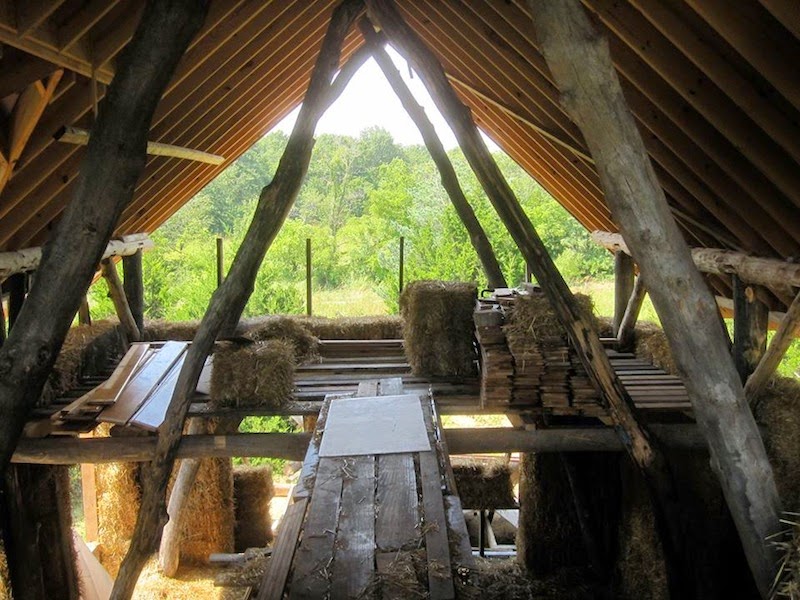
Bales in their staging space... our second floor! It was a good test of our newly installed oak floor beams,  showing only a sliver of deflection.

     
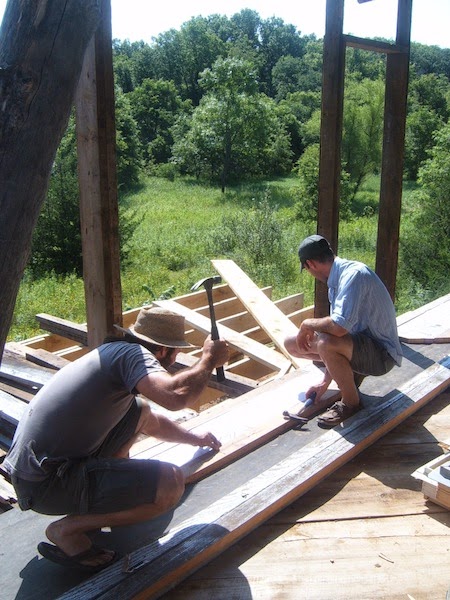
      Of course, preparations for this next bale-stacking stage have been seemingly never-ending. All of the detailing that needs to be thought out and installed ahead of bale really has been mind-jamming at points. First there was the "toe-up" you can see being installed by Mike and his cousin (who visited for a few days) around the perimeter of the floor platform. This elevates the bales in case of water pooling or some such disaster. It also help to distribute the load of the bales evenly across the floor joists. After that, there was the process of framing out the rough openings for doors and windows, with much detailing to come as we build out wide sills and seal up the gaps after installation. It took us much consideration of what heights would work for over-counter windows vs. bathroom windows vs. windows with bench seats in front. We have been combing through both used/donated and discount site-rejected windows at warehouses trying to match up U-factors and solar heat gain co-efficients with which direction they will be facing: to the south, we want high heat gain to maximize our passive solar design, and to the north, the opposite. We finally matched them all up and are happy with our selection of mostly wood, double-paned, low-e argon filled windows and doors for a fraction of the price new. All of this penny-pinching is getting a bit exhausting, but we knew this was one area where we could really blow our budget if we weren't careful! 

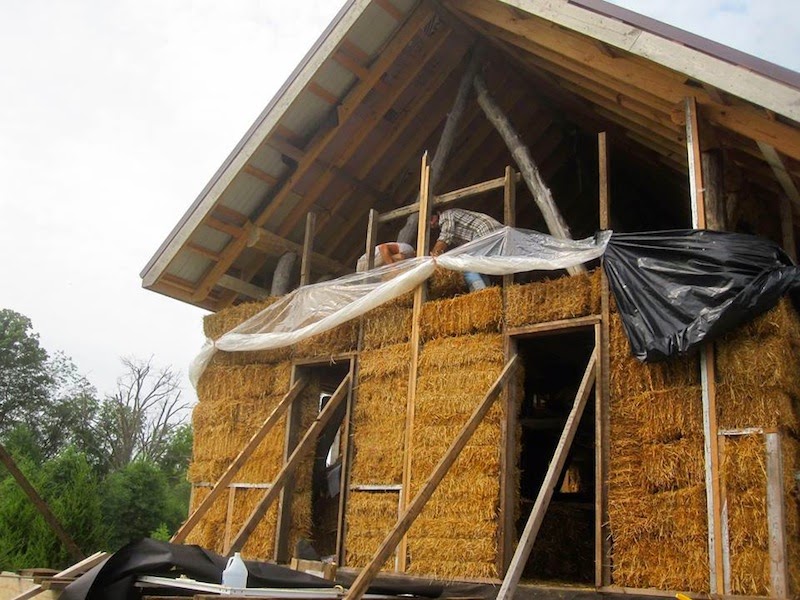
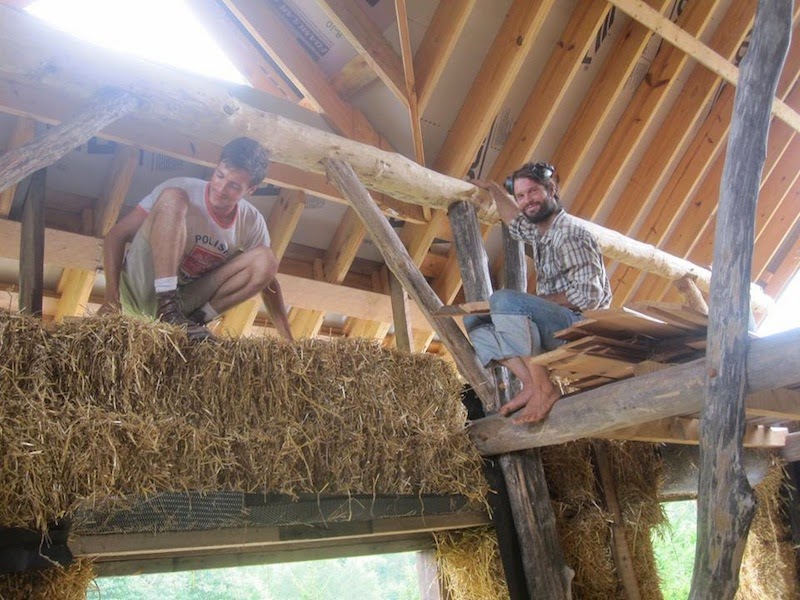
     After some more consideration of how to keep the bales mostly dry in perpetuity, we decided on a half-wall "rain screen" of vented oak siding, which of course needs support framing embedded in the bale. So again, another day spent measuring and cutting and installing for that. Just when the bales were beginning to seem like a distant reality, we realized one day that we were ready to actually start stacking! And once we started, we realized we were flying along, working at the pace of about one whole-house course per day. Notching the bales to receive the framing is the slowing factor for sure, but getting a good tight fit is worth it. When we reached a point at which we needed a smaller bale to fit, I was able to retie the bale into two half-bales with the help of our neighbor Beth's "bale needle," a long thin piece of metal with a handle and notch cut into it to feed some baling twine through the middle of the bale. The process, all in all, is actually pretty fun and satisfyingly quick, not unlike a giant set of children's building blocks. All of a sudden, our walls are closing in and things are beginning to feel very house like.

Threading the bale needle

Mike notching the bale the quick way, with chainsaw.
Handcutting with a saw, the slow way, is the method I prefer.

     So things are going swimmingly with our construction process, so what is the aforementioned trouble? About a week ago, we received word in our mail box (along with all of our neighbors) that within a half-mile of us a high-voltage power line (435,000V) is slated to be routed through. A midwest power company, Ameren (cue: ominous music and thunder claps), has deemed it necessary to extend their grid and I guess it looks like northeast Missouri makes a cheap and convenient shortcut from Iowa to Illinois. The route map was vaguely zoomed out, and we weren't sure where the two proposed options would fall exactly, but days before the first scheduled community meeting, they released images online. And wouldn't you know it? Our house is 900 feet from one of them! It would cut cleanly through our neighbor's land to the north of us, and perhaps would involve cutting some of our forest. This news, of course, is devastating to us and our neighbors, especially as we learn more about the health risks of living close to electro-magnetic fields and imagine what will happen to our beloved Bear Creek once it is shorn of its vegetation and flanking old-growth trees (somehow the route designers thought it best to run a route directly over a creek bed for several miles, I guess thinking no one would care about that land?). Our priorities now seem totally rearranged and we have been rallying as many neighbors as we can to speak out, but the problem is, the alternative route is no better. It would cut very close to our friend's the Crawford's land as well as Amish friends who live a few miles north. And directly over their Amish schoolhouse. And as I have talked to more people affected, I can see that part of their strategy is to divide communities and families and neighbors over this--for example, one of our neighbors, Lavern, would have one route go over his house or the other route go over his daughter and grandchild's house! Not okay!
      
     I suddenly feel very powerless and ill-equipped to be taking on a power company, and struggling to know the best strategy of resistance. Do we cooperate and politely suggest alternative deviations that would be less impactful? Do we get angry and threaten to fight? We and a group from our community talked with company reps at the meeting, registered ourselves and the particulars of our land--floodplains, oldgrowth, creek, marsh land, our Quaker meeting worship space, the homeschool, the education centers and new Catholic Worker house, plus all the houses of neighbors with small children and concerns about increased risks of childhood leukemia and like. We pointed out that several thousand young university students and environmental activists come every year from all over the country to our neighbor's education center and that we are no strangers to direct, non-violent action and protest (bless our friends for being onboard to resist with us!) I went door to door letting neighbors know and passing our surveys for them to send in to the company. Many of them are just as irate and freaked out as us. Now I am thinking about contacting local representatives and legal aid and seeing if there is any precedent for resisting such infrastructure: maybe they do have eminent domain and we are just plain screwed. Or maybe not? I am even going to look into environmental protections we could apply for ("gee... we have been seeing bald eagles in our neighborhood lately.... maybe there is a nesting pair in our woods?") This is everything I can think of so far, and I have no idea what will work, but I am feeling fired up with my love for the land and all the creatures that exist on it, especially the humans. And no, the irony is not lost on us that even though we are non-electicity users totally "off the grid" so to speak, the grid has found us none the less... 

So if anyone out there reading this has ideas about what would make an effective response in such a case as this, please let us know! The next round of meetings is in October. And we will learn December of their final decision. They have a website: www.ameren.com/MarkTwain/Pages/MarkTwain.aspx

Saturday, July 19, 2014

The sweet and the stormy


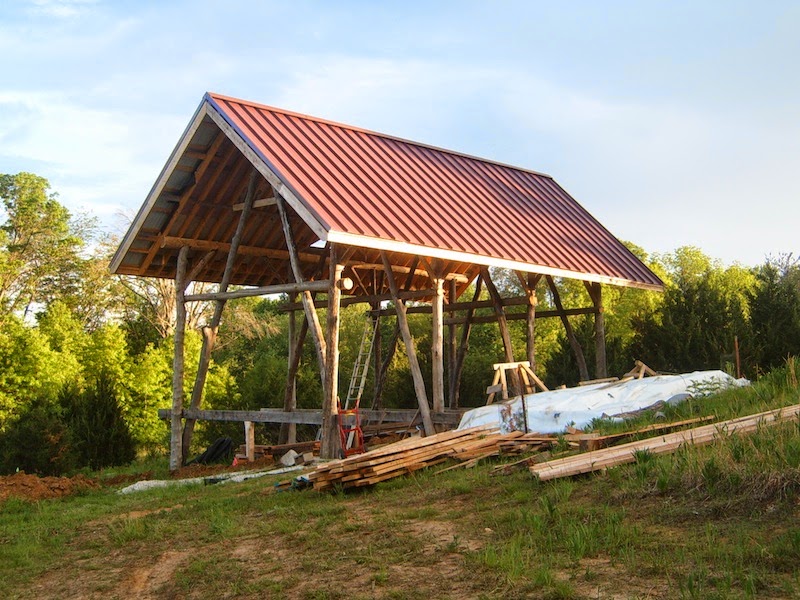
      This blog post is well overdue, and for that I apologize! The truth is that this past month or so has been somewhat overwhelming in both good and bad ways. Let me start with the good. We have a floor in our house now. And the floor has been enabling wonderful things. For one, I turned 32 in June and we hosted our first party in our house to celebrate! It feels exciting to finally have a big space to host gatherings in, the floor having turned our cumbersome large frame into an open-air pavilion of sorts. It has been suggested by several friends that we should just keep it this way... with 360 views, the sunset in the background lighting up tree canopy on the opposite side, the birdsong and breeze all providing the backdrop for our gatherings. Well, it does feel kind of perfect on evenings such as these! But come November, I have a feeling we will be glad for some insulated walls, even if they do compromise the views. 

     The floor itself was a score--old barn wood that a nice local man gave us a good deal on. The patchwork nature of old paint, weathering, and different plank sizes once puzzled together makes for a collage of sorts underfoot, and I find myself thinking that my grandfather (himself a collage artist and sculptor) would appreciate the aesthetics of it. Eventually, it will get covered over with finish flooring, but for now I have been admiring it and ruminating on creating a house is not that far off from creating a huge artwork of sorts, a giant sculpture. Our friend's children seem to get it, and have been inspired to create their own masterpiece houses when they come over to gatherings. It is nice to lose track of what they are doing for an hour and then look up to see several three year olds working together to lug a heavy log over to their play house. Built-in mailboxes, chicken coops, gardens, windows, and a giant catapult have all manifested in their joint creations. It is fun to witness how cooperative, imaginative, and creative these kids are when given some friends, a patch of dirt and some scraps. Not unlike their parents!


      What else? On the 4th of July we celebrated another Inter-dependence Day at our friends John and Holly's farm. Holly is a talented acupuncturist who recently treated a client she knew couldn't afford services. He runs a fireworks tent and offered to compensate her in fireworks, and being the generous gift-economist that she is, she agreed and we all got to participate up close in one heck of a show in addition to the usual delicious feast! Mike's parents were in attendance, as they came for a "workation" to help us out for a long weekend. They were hugely helpful in framing out east and west porch floors (necessary to start baling) and insulating with cellulose under where the strawbales will sit. Mike's father Sam, himself a doctor in his usual work sphere, likes to jokingly grumble about feeling like he has been "restructured" into a lowly menial-work position in some communist regime. Hopefully some day they will be able to come and actually kick their heels up when they visit, reminiscing about which board and joint they were responsible for back in the old construction days...


     And mostly the weather has been beautiful, the butterflies and wildflowers have been abundant, and we actually have one patch of accidental garden growing along! I had almost given up in the poor soil in this one little bed as it stunted everything I planted in it last year. I mixed in some compost and all of a sudden we had volunteer squash and tomatoes (thank you half-finished compost!) Something of a three-sisters bed with the addition of lettace seeds that I sowed this year, the squash leaves have been shading the lettace to extend its season by almost a month, and the tomatoes pop up above the broad squash leaves. We have barely had to weed, and now our mystery squash are revealing themselves to be... spaghetti squash! It has been an unexpected treat to watch it all unfold, and hopefully to eat as long as the rabbits don't discover it first.


     The last treat of the season has been a new birth in the neighborhood. John and Regina's healthy new baby girl Johanna arrived right on schedule, and thanks to our local midwife Alyssa and her team, it happened "naturally" right down Frontier Ln. at their home! In fact, Regina gave birth in a tent that she set up for the purpose. I have to admire them for their courage in having a baby their first season on their land, still a bit half-homed at the moment. While they hoped to have a small cabin finished, it just hasn't happened (construction projects tends to run notoriously late in case you hadn't noticed!) Still, they have big support in our community who have all been pitching in to cook meals and wash diapers and such. And I know they will figure out something for winter, perhaps renting in town. I have been trying to imagine what it would be like to have a small infant along for the journey with us in our given circumstances, and it just seems like it would be overwhelming if not impossible. Yet women worldwide manage it somehow, even in the midst of war and displacement and natural disaster! And Regina is one of the strongest and most determined mothers I have witnessed, biking to her midwife appointments (at 8 months pregnant, 15 miles away!), working on their house up until the last weeks. With such a beautiful little being in your midst, it is hard not to have faith that all is possible. I trust their family will prevail, and the amazing weather this past week feels like a small blessing on them while they recuperate and settle in.


     Okay, that leads me to the bad-overwhelming of late. Mike left with his parents a few weeks ago for a family reunion, and almost as soon as he left, disaster struck with me alone. A huge storm blew in with strong winds and almost hurricane like conditions. I am fortunate to have amazing neighbors Brian and Teri who were tracking the progress and came down to get me right before the worst hit. It was eerily calm and I had fallen asleep waiting for something to happen. I figured that this, like most storms, wouldn't really do much damage to our campsite and we would weather-through okay. Thankfully, Teri woke me up and we drove up to their house where I stayed overnight because the next morning when I came down to check on things, I found that our tallest tree, a massive 70 ft. red oak, had cracked at the base and fallen just feet away from our tent structure. In fact, it landed right where my car had been parked the night before. It took out two smaller trees with it and the whole mass of trunks and branches somehow miraculously had fallen in the negative space between our structures! This has been my worst fear camping out for years, and I have crouched in terror listening to thunder getting closer and closer in past storms. As overwhelming as it has been to start cleaning up the mess, I just feel so lucky to have not been there! It turns out that the base of the tree was quite rotted in the interior and it was a bit of a ticking time bomb. I'm grateful it chose to wait until we weren't there, and to fall in the least-damageful way possible (as if it did indeed "choose" any of that!)


      I have also been feeling somewhat daunted by the next hurdle in our building process-- and that is that we have no straw bales. It is straw season, and yet all the local farmers I have talked to have had miserable wheat crops, not even worth harvesting, thanks to hale/storm damage. Too much rain has meant straw hasn't dried properly either, so we are having to widen our search considerably. Plus less and less farmers are square baling, opting for big round bales instead. Our kind neighbors (who have saved our skins more than once) Don and Dana have been racking their brains and making all the calls they can to farmers they know, and I just placed an ad in our local "trader" newspaper... "desperately seeking straw!" Or something like that. We will see if we get any nibbles back. We may just have to bite the bullet and pay extra to have it trucked in from afar. Or to have someone's last years straw re-baled into squares. I guess sometimes you luck into the good deal, and sometimes you have to pay the piper for forces out of your control... Funny the reversal of weather prayers issuing from our mouths-- in past years, it was for rain to break the drought, and this year, it is for the storms to stop and a nice long drought month to help us get some rain-sensitive baling work done on the house! The next blog post will tell. In the meantime, I have been notching in our second floor beams, stalling for bales, and for Mike to return. The time to start making progress on the house is here... framing in our doors and windows, nailing in our toe-ups, ordering materials for plastering and flashing and a dozen more things it seems. Wish us luck and some dry weather!

Thursday, June 12, 2014

Nature, red in tooth and claw

      Late spring in Missouri, I am learning to expect the full onslaught of natural forces. From tick population explosions, to voracious weed growth, to wild storms resulting in flooded roads and fields and mud everywhere, our world here spins uncomfortably out of control for a few weeks. Okay, maybe a month. I suppose we are not the only beings entering into the season with full energy to get growing and moving, but it does feel uncomfortable at times to be living outdoors in it all.

      Last week brought 6 inches of rain in two storms, one of which had our neighbors hitting their storm shelters and whatever glass-shatter-free safe zones they had indoors. It brought 90 mph winds, quarter-sized hale, and a heat lightning storm (lightning flashing every second, making for a strange strobe-like effect) that lasted four hours as I was counting before I fell asleep. We have been opting to weather out the fierce storms in our tent, mostly in order to help hold up the thin fabric walls from ripping apart in the high winds and to protect our campsite. I could feel hale driving sideways, hitting my hands in sharp pricks from the other side of the tent wall as I braced it. But fortunately the little thing held through the worst of it, as did our house frame, and we made it through with only a broken mug to show the damage in our outdoor kitchen of the harrowing experience. Though the next morning we woke to find our wood-chipped driveway full of little rivulets of runoff water, making their way down to our creek, having pushed all of our carefully arranged chips into a mass at the bottom of the hill. Argh. Still, as people in the area had much more serious damage to trees and roofs, I can't complain. An unexpected silver lining to all the rain has been that suddenly all of our dormant shitake-innoculated logs flushed and exploded in mushrooms! So we have been feasting lately. Plus the mulberries have popped in the first of the season's fruits, so delicious, very worth the purple-stained hands and mouth.


     As uncomfortable as it feels at times to be living in a soggy, tick-bitten, unpredictable world with little refuge in the way of shelter, it is also equally marvelous to be up close to it. To watch a giant blue-grey mass of storm clouds piling up and coming closer and closer, to wade down though the flooded field and watch the creek beds spilling over, to walk across a field and almost step on a giant black rat snake before its muscular scaly body writhes away, to witness the totally bizarre flight of a hummingbird's mating dance, or have a butterfly land on your arm.... all totally stop me in my tracks and thoughts with wonder. One of the most amazing natural events I have witnessed happened a few weeks ago when Mike and I were visiting our neighbors the Crawfords. We were out in the garden with them and their daughter Melanie chatting and doing little garden tasks on a beautiful breezy blue-skied afternoon when out of nowhere a frenzy of winds touched down in the pea bed and whipped up a big mass of straw mulch. This kind of thing may happen all the time without our seeing it, but the fact that the straw had been drawn violently up into the tumbling whirlwind made the normally invisible visible to us dumb-founded witnesses. We all had stopped mid-sentence, mid-task, and just stood riveted as the straw tumbled round and round, higher and higher into the air. We watched until we couldn't see it anymore, it had been lifted so high into the clear blue, some of it dropping delicately down to land on the tree tops in the distance. How did that come to be on such a mild calm afternoon? And so perfectly staged in front of us, the chance audience? I feel like a new pupil in the ways of the wild world, and I am learning to soak up the mystery of it all as it comes without definitions or easy answers, which my mind craves regardless.


     Okay, enough of the poetic! The brass tacks of what we have been up to lately with out little slice of  wilderness is that we have been putting in the floor on our house! After weeks of scouting out materials from local mills, people's barns, restores, and the like, we have spent the last week with my work-ationing parents (and guest star Aunt Jane) hanging joists and tacking on plywood underneath them to create what will be our insulated first floor. It is at its lowest point one foot off the ground (making for a tight squeeze, on our backs to get plywood hung), and on its highest point around three feet off the ground. Thanks to the help of my family, we were able to get the whole thing up in a week, and what a difference a floor makes in defining the "housiness" of a structure! No longer can we be mistaken for Missouri's largest and weirdest deer stand! The only problem with defining our first insulated cavity is that I have become a bit paranoid about mouse entry-points. No crack or hole seems too small, and we have taken some extra precautions to patch and reinforce weak spots. We also dug in our greywater pipes and exit-points from the house, burying the line away from the house a little ways to a spot where we can put in a greywater garden and fruit trees, (one day, with all the left-over energy we will have at the end of all this!) So now that we have drain pipes and floor in, we are beginning to think "walls," and with straw-baling season a few weeks away, we are right on schedule.


Tuesday, May 27, 2014

Digging In


        We have arrived back to Missouri for the spring, this year greeted at the end of a long drive by a wonderful sight: our house frame and roof still standing, cheering us home again! It feels good to be back with one heck of a season's tough work behind us, and one exciting season of work before us. Now that we have been here for about three weeks or so, I can say that our activities for this first month seem to be organized around a central theme--and that is digging. Digging drainage ditches, digging in little tree saplings, shoveling wheelbarrow after wheelbarrow of top soil and woodchips to add to our swales, turning up the soil in our one small garden bed, etc. Spring seems like a time for robust digging in, literally and metaphorically, into new projects. Not that I am complaining, because despite somewhat sore backs and tired bodies, it is all work that we are excited to be doing: each shovelful seems to bring our dreams that much closer to becoming realities.

Our little home away from home...

     I also can't complain about the moving-in process. Setting up camp this year has also been relatively painless and quick compared with our process last year (which involved building a covered living structure, setting up roof-catchment water systems, building storage systems in our shed, and getting our mulched outdoor-living areas established to name a few projects!) We were mostly unpacked and set up in one day, with some basic reorganization, planting pots and beds, and re-mulching in the following week. Our neighbors were also generous to feed us our first few days of meals while we got our kitchen set up for outdoor cooking again. In fact, the first weekend we arrived was fairly full of celebrations, potlucks, clothes-swaps and gatherings of various kinds. We arrived in time for this year's May Day celebration which involved erecting a May poll, music, dancing, weaving ribbons around and a big delicious feast. And despite having missed the first days of leaves budding out on trees, which is always kind of miraculous to witness, we also missed the last blasts of cold April weather and have for the most part been enjoying sparkling warm spring days.

May Day, with last year's may poll ready to become this year's campfire


     Although we are eager to start putting in the first floor of our house, what lies beneath comes first and tackling all the drainage issues has required a solid week or more of digging. Putting in perforated black drainage pipe and gravel around the perimeter of the house, and building little retaining walls out of "urbanite" (chunks of broken-up old concrete) around the banked earth of our north and east sides has been quite a bit of a work, shovelful by shovelful. We have also started thinking about how water is going to move in and out of the house, and we have dug in a ditch under the house for "greywater" (which is waste water from kitchen and bathroom minus "blackwater" from a flush toilet) to drain away and out to a greywater garden planted to absorb it close by. As we have muddled through these steps, I am once again struck by how much work and expense a basic house is to construct! Still, the creative process of it all is rewarding and in the end, I am sure we will value it all the more for all the work that has gone in.


     The spring rains this year have been much more paltry than last, and so our pond has not filled to full capacity. We thought we would be spending more time this spring planting out native wetland plants and starting to introduce fish into it, but instead we have opted to focus on planting out our hugel-swale system. You may remember this swale system from posts from our first year if you have been following the blog, but if not, they are basically ditches dug on contour on a south-facing slope on our land, about fifteen feet apart, and we added some rotting logs into the downhill mounds under the dirt relocated from digging. Last year they were looking a bit weedy, but we didn't have much time to pay them attention. This year they have been lavished with weeding, compost and topsoil, seeded with a mix of clovers to pull nitrogen from the air and fix it in the soil, and they are getting their first plantings! We ordered eight cultivated pear and apple trees to start, and added in twenty-five nitrogen-fixing shrubs, called false blooming indigo, available from the conservation department. We also are planning to add in some more nitrogen fixers (to be discussed in the next post)and what, in the permaculture world, are called "dynamic accumulators," which all have long tap roots to draw up deeper levels of nutrients and make it available at the surface level. These are things like comfrey, burdock, horseradish, and jerusalem artichoke. Finally spending time to get these planting "guilds" established has been very exciting, and so work that it has taken has flown by fairly easily.


     Among our native "neighbors" that are becoming more and more familiar to us--treefrogs, inchworms, monarchs and swallowtails, hawks and vultures, songbirds, mice (not such a welcome one), snakes, herons, migrating geese, wild turkeys, rabbits, squirrels, and many more--we have some new human neighbors down the road. After considering it for a year, John and a very pregnant Regina moved on to thirty acres down the road to start, or perhaps relocate, a Catholic Worker farm. They have been running The White Rose CW for years in Chicago, juggling both some farming and lots of hospitality and activism, but lacking a real space for it all. Here, they hope to have room for several more singles, couples, or families to join them in running a farm and providing hospitality for folks who need a temporary space (and all of this non-electrically!) I think they are up for the challenge, as they have already tackled quite a bit and seem pretty resilient to the challenges of our off-the-grid lifestyle and location. They purchased a pre-built cabin in need of some repair and have been focusing on fixing it up and getting it livable for the baby soon-to-come, with lots of help of volunteers and community work parties. We are very excited to have them joining the community and hope to partner with them in their vision in future years. Once again, our wonderful neighbor Don Miller helped move a cabin into place with his tractor, making it his fifth house moved/raised in our community in as many years! Thank goodness for the help of community!

      Well, spring edibles beckon me in the forest--morels, wood nettles, and the black locusts are blooming (we have been making delicious sweet fritters with the edible blossoms) so I had better leave off here... A delicious spring to you all!

Friday, May 9, 2014

Self-Reliance


"Can there be anything so elegant as to have few wants, and to serve them oneself?"
-Ralph Waldo Emerson

     As we transition into our chosen way of life in Missouri, I am aware that we are not by any means "pioneers" but simply two more people stepping onto the well-worn path of self-sufficient life, meeting our own small human needs by living off of the land. Our story is not so dramatic or interesting as many who have chosen this path before us, and having their stories in mind has given me renewed inspiration and courage to try what sometimes seems crazy and impossible.


     Perhaps the first story of self-reliant homesteading I encountered years ago was that of Helen and Scott Nearing. They created a life on the land in Maine starting in the 1930s, leaving respectable university careers, building a stone house by hand and gardening during the short Maine growing season. They proceeded to teach and write about their experiences in a series of books about "the good life," advocating for a balance of physical and contemplative practice, and inspiring hundreds of young people who would come and visit them. Reading their book The Good Life was a revelation to me when I read it, that homesteading was something possible, at a time when I knew nobody living that way. It's funny to think back on that now, as I have come to know so many farmers and homesteaders, but I guess being raised in a city and suburbs, I just wasn't exposed to it. I am sure that they paved the way for many countless others as well.

Harlan and Anna's waterfront homestead at Payne Hollow


     Another inspiration are the lives of Harlan and Anna Hubbard (who were made well known through the writings of Wendell Berry). They lived on the banks of the Ohio River, first in a shanty boat that they traveled up and down the Mississippi on, and then on a homestead that they built from scratch. They caught, raised and grew all of their own food and lived without electricity or a vehicle up until their final days. Although they sound fairly "uncivilized", they played classical music (Anna on the grand piano and Harlan the violin) and read great works of literature together daily, and Harlan wrote about their life (Shanty Boat, and Payne Hollow) and painted prolifically. When Berry discovered them by chance one day, he was deeply inspired and went on to write the book, Harlan Hubbard. He also wrote about a particular experience when he was involved in organizing a protest of a nuclear facility nearby them, which he tried to convince them to join in. They declined, and the realization that their entire lives were a protest far more meaningful than his singular action deeply impressed him and surely influenced him in his return to his homeland in Kentucky where he continues to this day to farm (with draft horses) and write essays, novels and poems (on a typewriter) with the help of his wife Tanya. His books are too countless to mention in their entirety, but some favorites of ours are The Mad Farmer Poems, Jayber Crow, The Unsettling of America, The Gift of Good Land, and Home Economics. His life and writings are also a huge inspiration to us, to say the least.


      Of course, there has also been Henry David Thoreau's experiment living off the land at Walden Pond in Massachussets, which, though it only lasted two years, sent out huge ripples thanks to his writing about the experience in his book Walden. I finally read it last year and was struck by how much of it I could relate to almost two centuries later....

"I went to the woods because I wished to live deliberately, to front only the essential facts of life, and see if I could not learn what it had to teach, and not, when I came to die, discover that I had not lived. I did not wish to live what was not life, living is so dear; nor did I wish to practise resignation, unless it was quite necessary. I wanted to live deep and suck out all the marrow of life, to live so sturdily and Spartan-like as to put to rout all that was not life, to cut a broad swath and shave close, to drive life into a corner, and reduce it to its lowest terms, and, if it proved to be mean, why then to get the whole and genuine meanness of it, and publish its meanness to the world; or if it were sublime, to know it by experience, and be able to give a true account of it in my next excursion."

    Gandhi's self-sufficiency activism and practice at his communal ashram in India are hugely influential to us and many: the salt march, spinning and weaving cloth, farming and raising animals. His concept of the duty of "bread labor," is something that has stuck with me: that we all have the responsibility to provide for our basic needs through basic labor. Growing our own food, raising our own animals, making what we need, eating more simply and consuming less  (or more mindfully) are all ways of doing our own bread labor. I am finding how much meaning and joy there can be in this kind of self-reliance work. I finally learned how to spin fiber into yarn this past year, inspired by Gandhi's simple daily practice, and I have been knitting and sewing many of my own clothes (none yet from cloth I wove from yarn I spun... wouldn't that be the extreme act of self sufficiency?) Sometimes the question pops into my head, "wouldn't it be far cheaper and easier to just buy this?" And the answer of course is yes, it would be. Still, I find it deeply rewarding to create some of the things I need in life, and I find that I treasure those things (or the things friends have handmade) so much more.


     Really, what the self-reliant lives of these inspiring people (and countless others) points to is that we don't really need all that much materially to live a good life, and it isn't out of our reach to provide for those needs ourselves. I read this line some time ago and wrote it down (though I have no idea who to attribute it to): "our actual needs are so much larger emotionally and so much smaller materially than we have come to describe them in American society". If one ducks out of the fray of media messaging encouraging the want and consumption of so many needless things, this becomes obvious. Yo-yoing back and forth between life in a tent in a field and the heart of a big city, I can testify to the fact that skirting commercialism is infinitely harder in some locations than others! I have a much harder time resisting the temptation to consume excess stuff when I am in the city, with so many stores, magazines, online ads, etc. surrounding me. When I'm in Missouri, surrounded by trees and wildflowers, mostly what I want more of are trees saplings and wildflower seeds! Oh, and a house :)

     I know I am not alone in being consumed by the feeling of wanting stuff. Many of us suffer from what has come to be called "affluenza". In the book by that name by authors Clive Hamilton and Richard Dennis, it is defined as "a painful, contagious, socially transmitted condition of overload, debt, anxiety, and waste resulting from the dogged pursuit of more." Without going into it too much, I think we can all agree it exists in America, probably more than most places, and it can be hard to escape from the feeling of wanting more, especially when its all around you and everyone else has it. I might add on an extension to the definition--we get overwhelmed with having too much. We accumulate so much stuff in our houses that it becomes a burden, draining us of our energy and resources just to maintain it all. There is this great quote by Wendell Berry that warns against this condition: "Don't own so much clutter that you will be relieved to see your house catch on fire." My own experience is that it takes quite a bit of mindfulness not to accumulate excess material stuff, to really keep checking back in with what my real needs are. My friend Beth is a master at this, and she has to be since her house is tiny- only 120 sq. ft.! She has only a few sets of dishes and utensils, only her most treasured books, only a few towels, only one small closet of clothes. She is constantly paring down further too. For anyone who needs inspiration to go the extreme in letting go of possessions, there is the 100 Thing Challenge, by David Bruno: if you could only own one hundred possessions, what would you keep? I haven't tried it myself, but I find myself thinking about it when pressed with the choice of whether to buy something or not--would this make my 100 thing list? Remember, Gandhi died with only a few possessions, including one bowl, his spectacles, a pair of sandals, and his robe. He sets the bar pretty high on what constitutes as "essentials".

Beth's tiny house on wheels

     So the ingredients we are finding useful in our journey to greater self-reliance are living more simply, utilizing what elements our environment has to offer to meet our needs, and last, learning skills to be able to transfer the raw materials around us into what we need. There are really no shortage of books, classes, volunteer opportunities, or apprenticeships to learn those skills, but it does take some intentionality to seek them out. Right now, our combined years of experience taking classes and volunteering on other people's house builds has resulted in a huge skill asset of being able to do most of the work to build our house. We are saving a small fortune in not having to hire professionals. We have also been able to harvest raw material from our woods and turn it into building materials, and fuel to cook our food with (plus harvesting some of that food as well). Not only are we saving money, but the process of doing it all ourselves has been incredibly rewarding. Every day I wake up excited to start our days work, and not once have I felt like it hasn't stretched my mind, body and spirit in the process of doing it. Our work has brought us closer to each other, our land, and our neighbors. So I highly recommend learning some hands-on skills! Cooking, growing food, crafting, building--start learning wherever your passion lies, and one skill will lead to the next. There are hundreds of schools and opportunities across the country, even in cities, where you can begin. I will list some of our favorite resources below when I get a chance... But for now, we just arrived back on our land and there are a hundred things to do and people to hug! Happy spring!